Why Did Cathy Kill Her Parents in East of Eden? Mr. Grew’s Death Explained
Netflix’s East of Eden spends considerably more time inside Cathy Ames’ life than earlier screen adaptations of John Steinbeck’s novel. Florence Pugh’s Cathy is still capable of manipulation and terrible choices, but the series also examines how control, humiliation, and her desire for independence shape the woman she eventually becomes. Zoe Kazan has said that…

Netflix’s East of Eden spends considerably more time inside Cathy Ames’ life than earlier screen adaptations of John Steinbeck’s novel. Florence Pugh’s Cathy is still capable of manipulation and terrible choices, but the series also examines how control, humiliation, and her desire for independence shape the woman she eventually becomes. Zoe Kazan has said that she wanted Cathy to feel like a person rather than simply an archetype of evil, while still rooting her story in Steinbeck’s text.
Two events from Cathy’s youth become especially important in understanding her later actions. Her teacher, Mr. Grew, becomes obsessed with her and eventually takes his own life, while Cathy’s parents later die in a house fire that she deliberately creates. Although both tragedies become associated with Cathy, her responsibility for them is very different.
Cathy Does Not Kill Mr. Grew
Mr. Grew dies by suicide after Cathy rejects him, but she does not directly kill him. What makes the situation disturbing is that Cathy understands the power she has over him and knowingly encourages his attention for a time.
Cathy has already discovered that the appearance of innocence allows her to influence the people around her. Boys give her presents and adults readily accept the version of herself she presents to them, while few people make an effort to understand what she is actually thinking. When Mr. Grew becomes interested in her, Cathy recognizes another person whose feelings can be manipulated.
The relationship is inappropriate from the beginning because Grew is her teacher and Cathy is still his student. Rather than immediately exposing him, however, Cathy lets him believe that his interest is reciprocated. She allows him to accompany her home and keeps enough possibility alive that Grew begins imagining a future in which they can openly be together after she leaves school. For Cathy, the attention initially seems useful and even entertaining. The problem begins when Grew stops behaving like someone she can easily control.
Why Does Cathy Reject Mr. Grew?
Cathy eventually realizes that Grew’s attachment has become dangerous. He is no longer satisfied with a private flirtation and begins acting as though Cathy will eventually belong to him.
His behavior becomes increasingly reckless, including coming near her home at night and risking discovery. Cathy understands that if his obsession continues, the secret arrangement could take control away from her rather than giving her control over him. That is the point at which she ends it.
Grew cannot accept the rejection. He later arrives at the Ames home intoxicated and looking for Cathy, forcing her father to intervene. The following morning, Cathy learns that Grew has killed himself.
His death leaves Cathy with an uncomfortable realization. She may not have physically caused it, but she knows that she deliberately encouraged his obsession and then withdrew from the situation once it stopped serving her. The experience becomes an early lesson in just how destructive her ability to manipulate people’s desires can become.
Also Read: East of Eden Filming Locations
Why Does Cathy’s Father Punish Her?
The aftermath of Grew’s death also exposes the nature of Cathy’s relationship with her father. Instead of focusing primarily on the fact that an adult teacher had been pursuing his daughter, Mr. Ames becomes preoccupied with Cathy’s role in attracting his attention. Grew’s drunken visit gives him enough information to suspect that Cathy had encouraged the relationship, and he responds with severe physical punishment.
More important than the punishment itself is what her father tells her. He speaks about Cathy as though she belongs to him and treats her sexuality and reputation as possessions that he has the right to control. That becomes a turning point for her. Cathy already feels that the people around her see an image rather than a real person. Her father’s behavior confirms something even more frightening from her perspective: remaining in the Ames household means continuing to live under someone else’s authority.
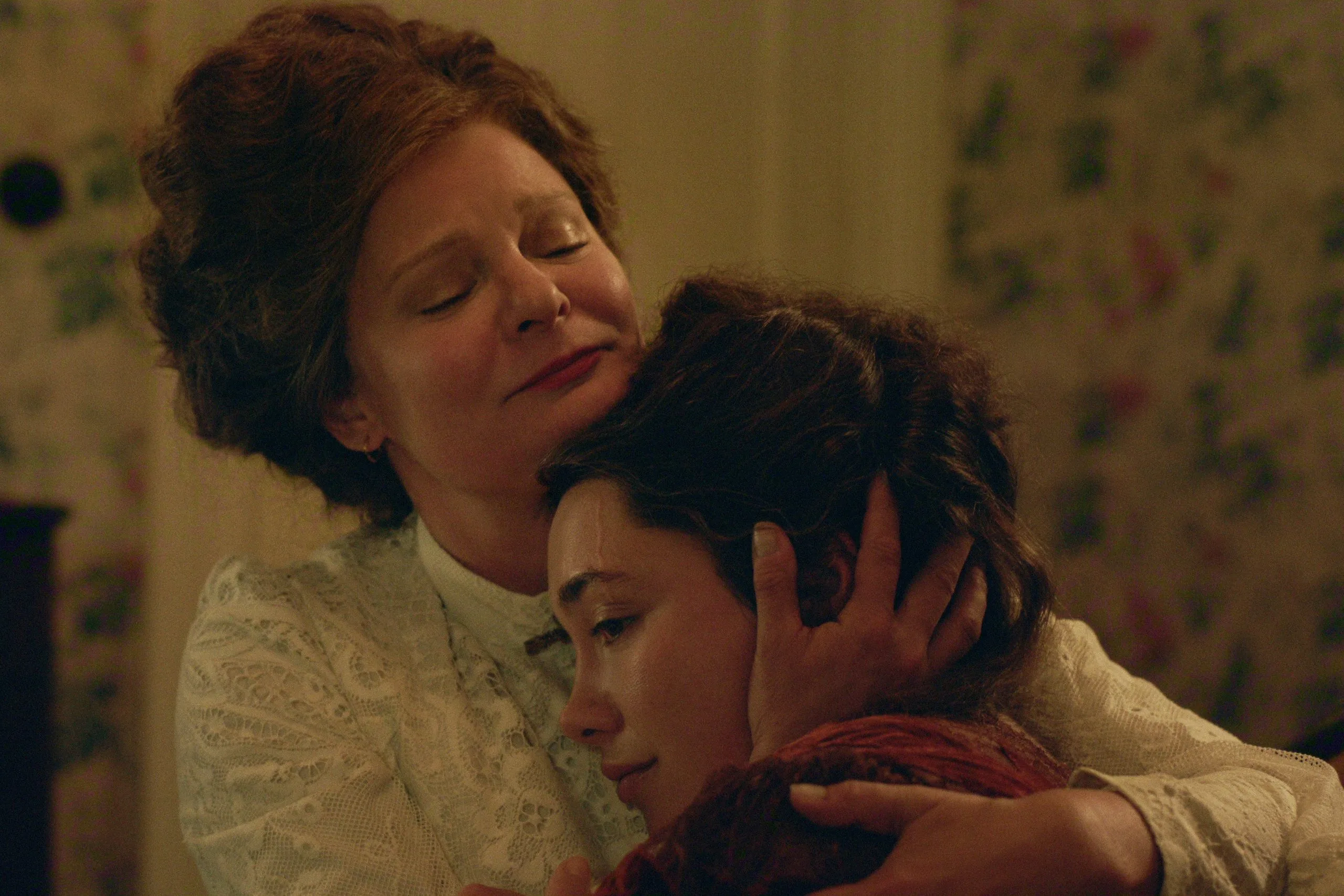
The series does not use this experience to excuse what Cathy does next. It does, however, provide a psychological path toward it, which fits the adaptation’s broader interest in looking at what people inherit and what they choose to become.
Cathy Deliberately Kills Her Parents
Unlike Mr. Grew’s death, the deaths of Cathy’s parents are planned. After deciding that she wants to escape her family completely, Cathy takes money from her father’s safe and prepares to disappear. Simply running away would leave open the possibility that her parents could search for her, so she creates a much more elaborate solution.
Cathy sets the family home on fire while her parents are inside. She then uses her belongings and blood from a chicken to create evidence suggesting that she herself was attacked and taken away. The deception serves two purposes. Her parents can no longer control her, and anyone investigating what happened is encouraged to believe Cathy was another victim rather than the person responsible.
Effectively, Cathy kills her parents and Cathy Ames at the same time. The girl believed to have disappeared in the tragedy can no longer be followed or brought home. With her family gone and the authorities looking for a victim rather than a fugitive, Cathy is free to construct another identity.
Did Cathy Kill Her Mother Intentionally Too?
Her father appears to be the more immediate target of Cathy’s anger, but Cathy knows that setting the house on fire will also place her mother in fatal danger. That makes her mother’s death part of the choice even if the series gives Cathy less personal hostility toward her.
This is important because it prevents Cathy’s actions from being reduced to straightforward revenge against an abusive father. She is prepared to destroy anyone and anything connecting her to the life she wants to leave behind. Her idea of freedom is therefore already becoming extreme. She does not merely want more independence inside her family. She wants to remove every claim that another person might have over her.
That trait follows Cathy through the rest of East of Eden. Adam later makes the mistake of believing his love can anchor her to the life he imagines for them, just as other people assume they can define what Cathy should want. Again and again, she responds to confinement by attempting to break it.
Mr. Grew and the Fire Explain Two Different Sides of Cathy
Putting the two incidents together reveals why they are so important to Cathy’s story. Mr. Grew demonstrates the danger of Cathy’s desire to control other people’s feelings. She plays with his affection because she believes she can manage it, only to discover that another person’s obsession can take on a life of its own.
Also Read: East of Eden Cast and Character Guide
Her parents’ deaths reveal something colder. When Cathy feels trapped herself, she is capable of planning an irreversible escape and accepting the consequences for other people.
That distinction is central to Netflix’s version of the character. Cathy is not presented simply as someone whose every action comes from unexplained wickedness, but understanding the forces acting on her does not erase her responsibility for the choices she makes.
It also connects directly to one of the adaptation’s central ideas. Netflix describes the story as one in which characters repeatedly confront the reality that they ultimately become what they choose. Cathy’s childhood explains some of the forces pushing her toward the person she becomes, but her decisions remain her own.