Is the Algorithm Human in Silo? Bernard’s Final Discovery Changes Everything
Silo Season 3 Episode 9 does not confirm that the Algorithm is human, but Bernard Holland’s (Tim Robbins) final confrontation with the voice gives us the strongest reason yet to question what it really is. Bernard notices something important when the Algorithm rejects what he sees as a logical compromise and responds with distinctly human…
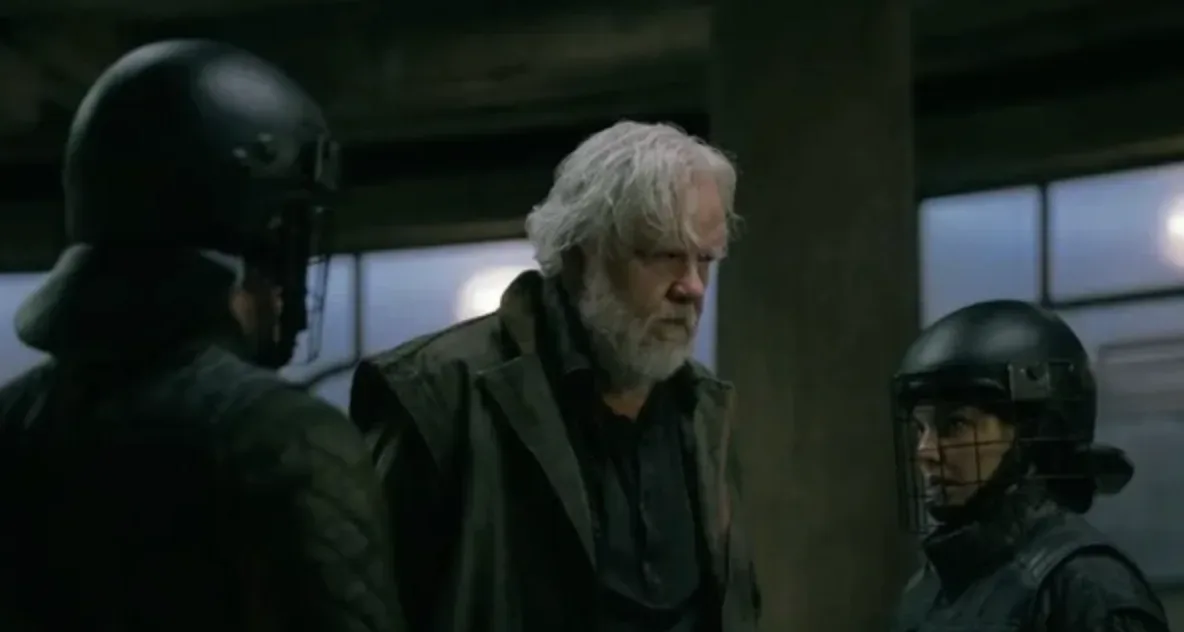
Silo Season 3 Episode 9 does not confirm that the Algorithm is human, but Bernard Holland’s (Tim Robbins) final confrontation with the voice gives us the strongest reason yet to question what it really is. Bernard notices something important when the Algorithm rejects what he sees as a logical compromise and responds with distinctly human impatience, while earlier conversations with Camille Sims (Alexandria Riley) have already shown the voice capable of frustration and even consolation.
That does not automatically mean a person is sitting somewhere speaking into a microphone. What it does mean is that Bernard dies believing the authority controlling Silo 18 may be less perfect, less objective, and potentially far more human than everyone has been taught to believe.
(Full spoilers follow for Silo Season 3 Episode 9, “Farewell.” This article discusses Bernard’s final confrontation with the Algorithm and the episode’s closing nuclear blast.)
Is the Algorithm in Silo actually a human?
Silo has not confirmed that the Algorithm is human, but Bernard begins to believe the voice could belong to a person or a succession of people rather than an infallible artificial intelligence. His theory grows from the way the voice behaves, especially when it reacts to people instead of simply processing information.
The Algorithm knows things Bernard never knew, gives Camille instructions, controls the Safeguard, and speaks with the confidence of an authority that expects no appeal. For most of the series, that has made it feel almost godlike compared with the human leaders trapped underneath it.
Season 3 gradually chips away at that image. The voice worries, becomes annoyed, changes tone, and even tries to console Camille when the pressure of running Silo 18 begins to break her down.
Bernard finally puts those details together in Episode 9. He does not prove that the voice is human, but he reaches the far more dangerous conclusion that it may not be as all-knowing as everyone assumes.
Why does Bernard begin doubting the Algorithm in Episode 9?
Bernard begins doubting the Algorithm because its response to his surrender appears emotional rather than logically optimized. He returns from hiding with a proposal that, in his mind, should solve Camille’s political crisis more cleanly than a population-wide memory reset.
Camille is losing control of Silo 18, the truth about Vitamin D+ is spreading, and thousands of residents are angry enough to challenge Judicial. Bernard offers himself as the villain who can absorb the blame and give Camille a way to restore order.
He is already believed responsible for years of manipulation and has now publicly reappeared after everyone assumed he was dead. Camille could blame the conspiracy on him, execute him, close the case, and potentially avoid drugging the entire population.
The Algorithm rejects the proposal and insists on both Bernard’s cleaning and the continuation of the Vitamin D+ plan. That decision is what catches Bernard’s attention because it feels less like calculation and more like punishment.
Related: Does Bernard Die in Silo Season 3 Episode 9?
For years, Bernard interpreted the Order as proof that someone above him had already solved every problem. Episode 9 forces him to consider the far more uncomfortable possibility that the authority above him is improvising too.
Why did Bernard think his deal should have worked?
Bernard believed his deal should have worked because sacrificing one known conspirator offered a simpler path to public stability than chemically altering thousands of residents. His entire career was built around that kind of controlled political calculation, so he knows exactly how such a narrative could be sold.
Bernard is uniquely suited to become the scapegoat because he was mayor, head of IT, Juliette’s enemy, and one of the most powerful people in Silo 18. His return from the dead gives Camille a ready-made explanation for almost every recent act of resistance.
She could argue that Bernard manipulated Robert Sims (Common), protected rebels, interfered with Juliette Nichols (Rebecca Ferguson), and caused the latest unrest. Residents would have a villain they already understand, while Camille could present his execution as proof that the crisis had been contained.
More importantly, Bernard is willing to accept that punishment. He is not bargaining for his own survival, which is why the Algorithm’s refusal seems so strange to him.
If the voice only wanted stability, his proposal should at least have been considered. Instead, it appears to want obedience and retribution as well, which is a surprisingly personal instinct for something supposedly ruled by pure logic.
What clues has Camille given that the Algorithm behaves like a person?
Camille’s conversations with the Algorithm have repeatedly shown that the voice can respond to her emotional state rather than merely issue instructions. She argues with it, questions its decisions, and receives responses that sound tailored to her frustration rather than limited to commands.
Some of the strangest moments are the gentler ones. The voice has attempted to calm or console Camille, suggesting that it either understands human emotion exceptionally well or possesses something resembling emotional behavior itself.
That still does not prove there is a living person behind it. A sufficiently advanced AI designed to manage entire populations would need to predict fear, grief, rebellion, loyalty, and the psychological weaknesses of its operators.
Bernard’s point is narrower and more useful. If the Algorithm has recognizable behavioral patterns, then those patterns may be studied, predicted, irritated, and possibly manipulated.
That alone strips away some of its mystique. Camille has been obeying the voice because she believes it represents knowledge accumulated across generations, but Bernard begins to suspect she may simply be taking orders from another participant in the same experiment.
Could the Algorithm still be artificial intelligence?
Yes, the Algorithm could still be artificial intelligence because displaying emotion or human-like language does not prove a biological person is speaking. In fact, an advanced system designed to control 10,000 people would almost certainly need to sound human enough to influence the leaders responsible for carrying out its orders.
The Order itself already resembles algorithmic governance. It contains prescribed responses for rebellion, curiosity, relics, cleaning, population control, and other situations that threaten stability.
An AI sitting above that structure could plausibly adjust instructions when conditions change. It could also imitate empathy or anger if those responses make human operators easier to control.
The bigger problem is not whether the Algorithm has a human body somewhere. The more important question is whether it is actually as rational and reliable as Silo leadership believes.
If Bernard is right that its decision in Episode 9 is emotional or vindictive, then an AI explanation is not especially comforting. A machine can inherit the priorities, prejudices, and mistakes of the people who created it just as easily as a human operator can.
Is someone in Silo 1 speaking through the Algorithm?
Episode 9 strongly raises the possibility that the voice is connected to human authority in Silo 1, but the episode does not reveal who or what is actually speaking. Silo 1 has increasingly become the missing piece in the power structure that sits above individual silos such as Silo 18.
Bernard knows Silo 18 does not control its own fate. The Safeguard can kill the entire population, while the mysterious voice can direct local leadership without ever showing where that authority originates.
The Before Times storyline makes Silo 1 even more suspicious. Daniel Keene (Ashley Zukerman) is directed there during the opening ceremony while Helen Drew (Jessica Henwick) is sent toward Silo 18, and the people at the center of the project are gathered around Silo 1.
The show is placing the origins of centralized power in one timeline while Bernard questions that same centralized power centuries later. That parallel is hard to miss, but it still stops short of giving viewers a clean answer.
The voice could be a human operator, a chain of operators, an AI housed in Silo 1, stored consciousness, or technology the series has not fully explained yet. Bernard identifies the question, but his death prevents him from following it any further.
Why does the Algorithm still want Vitamin D+ used in Silo 18?
The Algorithm still wants Vitamin D+ used because erasing dangerous memories remains its preferred way of restoring control. Bernard’s alternative does not change the voice’s apparent belief that the population itself has become the problem.
Juliette remembers the truth about cleaning and another silo, while Robert remembers his betrayal of the old order and Mechanical remembers the violence used against them. Residents are beginning to connect those memories into a larger story about how much of their lives have been manipulated.
Vitamin D+ attacks that problem at its source by targeting memory rather than evidence. If the population forgets the rebellion, the reasons behind it become much easier to erase as well.
Camille accepts this logic despite knowing how destructive earlier memory resets were. Parents forgot children, residents became confused about their own lives, and people died because they could no longer trust what they remembered.
The Algorithm still considers those consequences preferable to an uncontrolled population. That is why Bernard’s discovery matters so much, because thousands of people may lose themselves based on a judgment that could be deeply flawed.
Walker (Harriet Walter), Knox (Shane McRae), Shirley Campbell (Remmie Milner), and Sheriff Billings (Chinaza Uche) therefore stop waiting for permission. They move to destroy the Vitamin D+ delivery system while Bernard’s cleaning pulls attention elsewhere.
What does Bernard’s discovery mean for Juliette after his death?
Bernard’s discovery gives Juliette permission to treat the Algorithm as a fallible opponent rather than an unbeatable authority. That may be more useful to her than any formal position Bernard ever held.
Juliette has never been particularly impressed by titles or institutions. Mayor, sheriff, judge, head of IT, the Pact, and the Order all lose their power over her once the machinery underneath them stops making sense.
The Algorithm was harder to challenge because it appeared to sit above all of those systems. Camille did not merely claim to know better, but claimed she was following an authority designed to preserve humanity itself.
Bernard attacks that assumption before he dies. He tells Juliette, in effect, that the voice can react, miscalculate, and possibly be manipulated just like any other system.
That idea suits Juliette far better than it ever suited Bernard. She has spent the entire series discovering that supposedly perfect systems contain physical flaws, whether it is bad tape, hidden cameras, poisoned air, broken generators, or a pipe that can be capped.
Bernard spent much of his life believing uncertainty justified obedience. Juliette has always believed uncertainty is a reason to open the machine and see what is actually inside.
How does the nuclear blast at the end of “Farewell” change the Algorithm mystery?
The nuclear blast makes the Algorithm mystery even more important because the episode finally reaches the moment when frightened humans hand extraordinary power to the silo system. Daniel and Helen arrive at the completed complex expecting a ceremonial event, only to be separated shortly before the old world collapses.
Daniel is sent toward Silo 1 while Helen is directed toward Silo 18. Both begin sensing something is wrong and try to find one another before a nuclear explosion tears across the horizon.
Within seconds, the silos stop being an ambitious survival project and become the only available shelter. The people entering them do so under panic, with no time to question who designed the rules that will eventually control generations of their descendants.
Centuries later, residents know almost nothing about that world. Books are gone, history is forbidden, relics are illegal, and even asking the wrong question can trigger punishment.
The Algorithm sits at the center of that long act of forgetting. Episode 9 therefore places Bernard’s suspicion beside the birth of the system itself and raises the uncomfortable question of who first decided that humanity needed to lose its memory.
Those rules did not begin as ancient commandments. Somebody created them, and Bernard dies realizing that all the machinery, ceremony, secrecy, and fear may have been hiding a very human decision from the beginning.