House of the Dragon Hid Helaena’s Final Prophecy in Plain Sight All Season
Helaena’s finished embroidery in the House of the Dragon Season 3 finale is not simply a record of the war. Its final images reveal that Helaena has been sewing her dragon dreams into cloth, including her own death and a disturbing vision of Rhaenyra on the Iron Throne surrounded by fire, dragons and suffering. The…
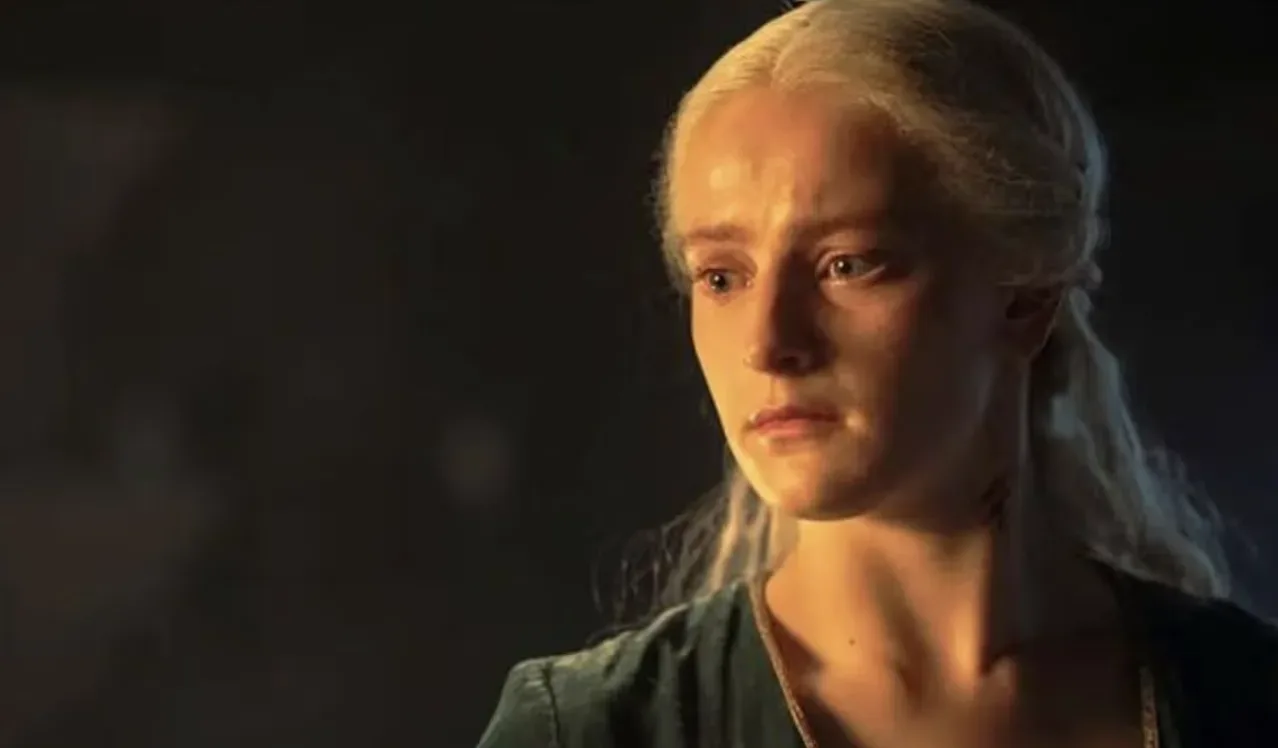
Helaena’s finished embroidery in the House of the Dragon Season 3 finale is not simply a record of the war. Its final images reveal that Helaena has been sewing her dragon dreams into cloth, including her own death and a disturbing vision of Rhaenyra on the Iron Throne surrounded by fire, dragons and suffering. The first image functions almost like Helaena’s farewell, because she completes a depiction of a woman falling from the Red Keep before taking her own life. The second is a warning about Rhaenyra’s reign, not straightforward proof that the gods approve of her. The tragedy is that Rhaenyra looks at the prophetic document and appears interested mainly in the image that confirms her own importance.
Spoiler Alert
Helaena embroidered her own death
The finale makes the connection unmistakable. After Helaena jumps from the Red Keep, Rhaenyra enters her room and finds the work she left behind. One of the completed panels depicts a woman falling from a tower, mirroring what has just happened. NPR and TVLine both identify the image as a representation of Helaena’s death.
This means Helaena saw at least the shape of her own ending before it occurred. What the show does not establish is exactly when she understood that vision or whether she believed it could be changed.
The Iron Throne image is not a happy prophecy
Another section depicts Rhaenyra sitting on the Iron Throne while the scene around her is filled with violence.
Dragons, fire and human suffering surround the throne. Rhaenyra may occupy the seat she has spent years fighting for, but Helaena’s image hardly presents that outcome as a peaceful triumph.
That is crucial because Rhaenyra has become increasingly convinced that prophecy proves her right to rule.
Helaena’s work offers something much less comforting: reaching the throne and destroying yourself in the process can exist in the same future.
Related: House of the Dragon Just Made Ulf’s Betrayal Much Bigger Than the Book
Why does Rhaenyra throw it down?
Rhaenyra’s reaction says almost as much about her as the images themselves.
She studies the embroidery, sees herself on the throne and then discards it. Emma D’Arcy interprets that moment as Rhaenyra rejecting another potential source of legitimacy or truth when it does not fit neatly into the worldview she has chosen.
Helaena could see things Rhaenyra cannot. Yet Rhaenyra has reached a stage where even supernatural evidence is useful only when it confirms what she already believes. The throne catches her attention. The destruction surrounding it does not stop her.
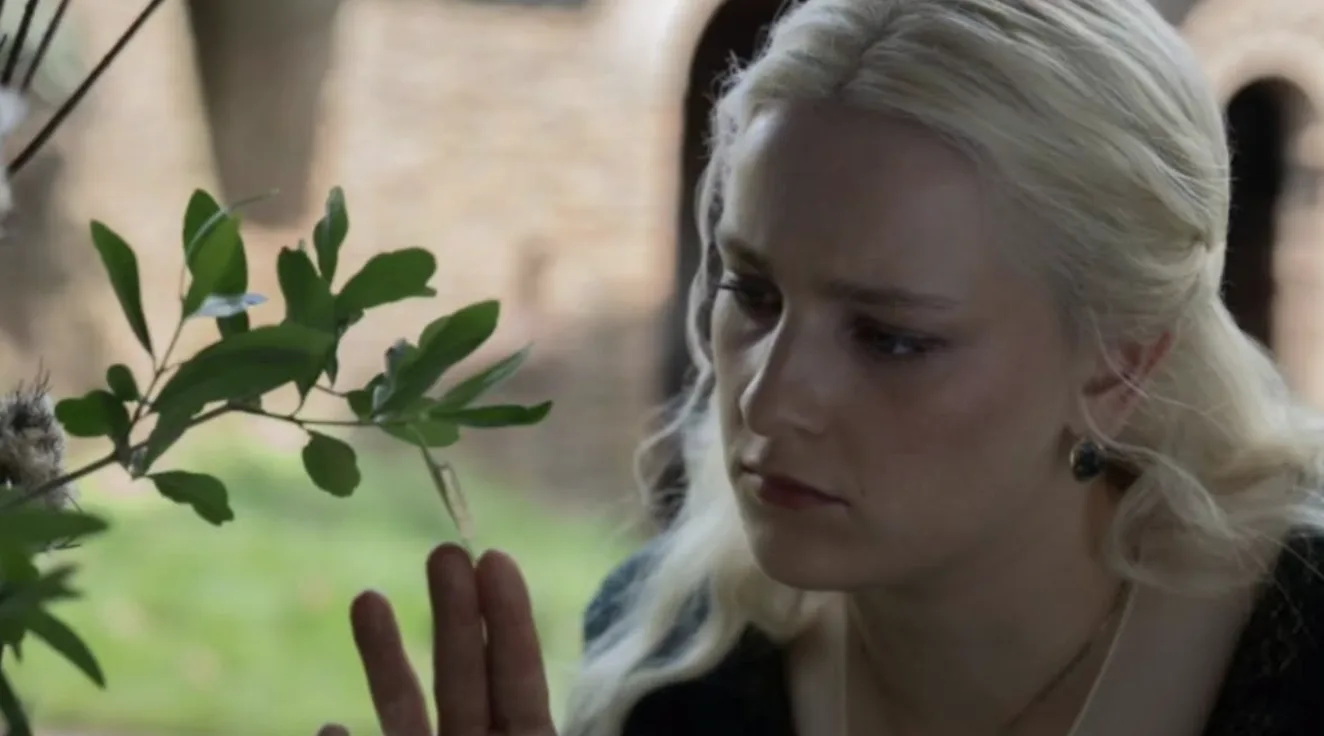
The opening credits were Helaena’s work
Season 3 quietly placed Helaena’s embroidery in front of viewers every week.
Phia Saban confirmed to Entertainment Weekly that the embroidery used for the season’s opening-title sequence is Helaena’s work. She said executive producer and writer Sara Hess informed her of that connection, turning what initially appeared to be stylized historical imagery into part of Helaena’s characterization.
That changes how the credits can be read retrospectively.
Helaena has been processing history differently from everyone else. Kings and generals try to control events through armies and proclamations. Helaena records fragments of what is happening, what has happened and what may still happen through images. The war’s history has literally been passing through a dreamer’s hands.
Did Helaena know all season that she would die?
Probably in some form, but the series does not confirm that she possessed a complete, fixed understanding from the beginning.
Saban specifically resisted reducing Helaena’s decision to one instant of realization. She described her path toward death as cumulative and noted that viewers do not repeatedly see Helaena sewing the exact image of herself falling. In retrospect, however, each return to the embroidery can be understood as contributing to the final work.
That is consistent with the way Helaena’s dragon dreams have always operated. She receives images and fragments rather than convenient explanations. Knowing a future exists is not necessarily the same as knowing every step that leads there.
Her prophecy is also a warning about Rhaenyra
The most consequential part of the embroidery may therefore be the section that survives Helaena.
Rhaenyra has just publicly attached her rule to prophecy and declared herself necessary to the survival of the realm. At almost exactly the same point, Helaena leaves behind an image linking Rhaenyra’s throne to destruction. Entertainment Weekly notes that D’Arcy views Helaena’s death as further isolating Rhaenyra and pushing her deeper into the path she has chosen.
The irony is severe. Rhaenyra desperately wants supernatural validation. A genuine dreamer leaves her one. It just is not the validation she wanted.
Related: House of the Dragon Just Changed Aegon and Aemond’s Story for Season 4
Helaena dies, but her vision remains
Helaena’s death removes one of the few people in the royal family who could perceive the war without wanting to dominate it.
Ryan Condal called her a uniquely innocent presence who was dragged into a political struggle she never sought. Her ability to see beyond ordinary experience gave her knowledge, but not the power to make everyone else listen. The embroidery preserves that contradiction. Helaena saw her own fall. She saw Rhaenyra on the Iron Throne. She also placed fire and suffering around that victory.
The finale does not tell us that every thread should be read as a literal roadmap of Season 4. Helaena’s visions have never been that simple.
But it gives Rhaenyra a warning she is emotionally incapable of accepting. For a queen increasingly convinced that destiny chose her, that may be the most dangerous prophecy of all.