Why Doesn’t Wile E. Coyote Talk in Coyote vs. Acme?
Wile E. Coyote spends “Coyote vs. Acme” at the center of a courtroom case without ever delivering the kind of spoken testimony audiences might expect from the plaintiff. That silence is intentional. Director Dave Green and screenwriter Samy Burch considered a version of the film in which Wile E. spoke, but the filmmakers decided that…
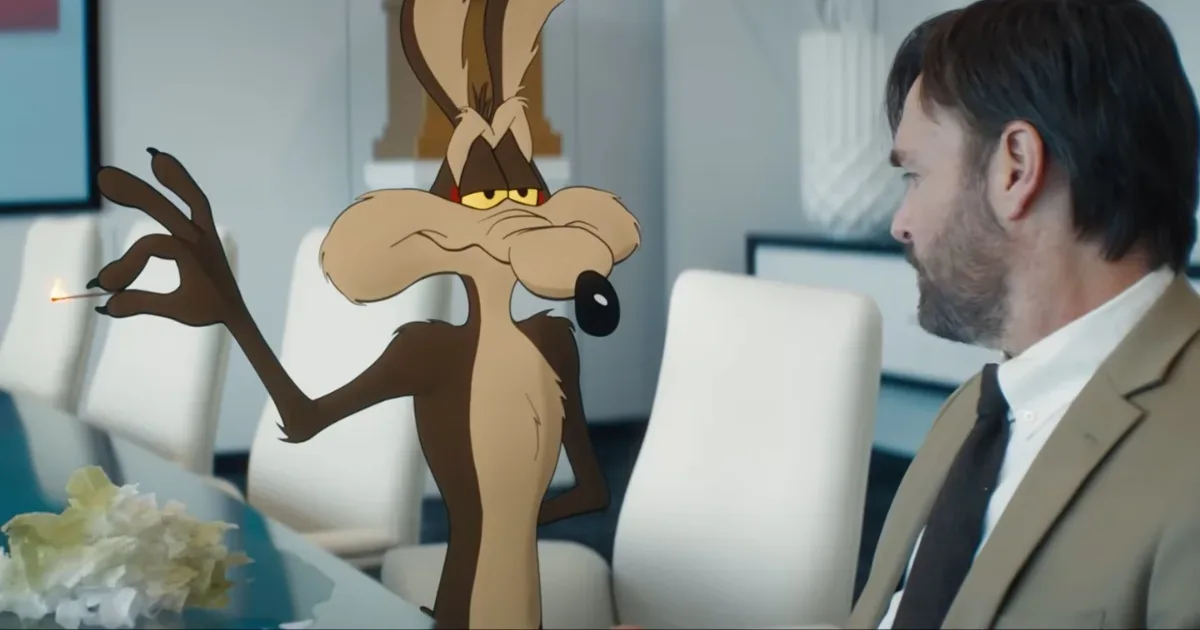
Wile E. Coyote spends “Coyote vs. Acme” at the center of a courtroom case without ever delivering the kind of spoken testimony audiences might expect from the plaintiff. That silence is intentional. Director Dave Green and screenwriter Samy Burch considered a version of the film in which Wile E. spoke, but the filmmakers decided that hearing him talk felt wrong for the version of the character they wanted to use. Instead, they treated him like a silent-film performer who communicates through expressions, physical comedy, signs, and the people around him. Wile E. is not canonically incapable of speech, however, because older Looney Tunes cartoons have shown him talking when he appears opposite characters such as Bugs Bunny.
Did the Filmmakers Ever Consider Letting Wile E. Talk?
Yes, the filmmakers experimented with a speaking version before deciding against it. Dave Green has explained that hearing the character speak felt strange and did not match the Wile E. Coyote he remembered most strongly. The production therefore returned to the version associated with the classic Road Runner shorts, where Wile E. communicates almost entirely without dialogue. That choice was not simply nostalgia because it also shaped how the movie tells its story. Putting a silent character at the center of a legal case creates the need for Kevin Avery to become his advocate in a very literal sense.
Green has compared Wile E. to a silent-film actor, an idea that screenwriter Samy Burch also used while developing the screenplay. Burch looked at performers such as Charlie Chaplin while considering how a character without dialogue could remain emotionally present for an entire feature. Wile E.’s face, posture, signs, and increasingly elaborate reactions therefore have to perform work that another protagonist might accomplish through speeches. His silence becomes part of the movie’s storytelling rather than a limitation the screenplay tries to hide. It also allows Wile E. to remain recognizably the same physical comedian audiences know from the Road Runner shorts.
Related: Are Wile E. Coyote and the Road Runner Actually Friends? Coyote vs. Acme Explained
But Has Wile E. Coyote Spoken Before?
Yes, which makes the question more complicated than saying Wile E. simply cannot speak. The character has a long history of talking in Looney Tunes cartoons where he encounters Bugs Bunny rather than the Road Runner. One of the clearest examples is the 1952 Chuck Jones short “Operation: Rabbit,” where Wile E. introduces himself to Bugs as a genius and spends much of the cartoon speaking in an educated, self-important manner. Mel Blanc supplied the voice, giving Wile E. a refined personality very different from the silent desert predator familiar from the Road Runner series. Several later Bugs Bunny encounters continued that characterization.
There are effectively two closely related traditions surrounding Wile E. Coyote. Opposite the Road Runner, he is generally the silent inventor whose confidence is communicated through drawings, signs, plans, and increasingly desperate expressions. Opposite Bugs, he has sometimes become the pompous “super genius” who confidently explains his intelligence before his scheme inevitably collapses. “Coyote vs. Acme” had to decide which of those traditions should define a feature built around Wile E.’s pursuit of the Road Runner. Green and Burch chose the silent version.
Why Does the Silent Version Work Better for Coyote vs. Acme?
Keeping Wile E. silent protects the physical comedy that makes his Road Runner appearances distinctive. His funniest moments often happen between the instant he realizes a machine has failed and the instant gravity, explosives, or some other catastrophe catches up with him. Dialogue could easily interrupt that rhythm. A slowly changing facial expression or a tiny sign held toward the audience can communicate frustration more efficiently than a paragraph of dialogue. The film therefore allows animation to remain Wile E.’s primary language even when he is surrounded by live-action characters.
The choice also gives Will Forte’s Kevin Avery a more important dramatic function. Kevin is not merely the lawyer who knows courtroom procedure while Wile E. handles his own case. He has to understand what his client wants, translate those concerns into a legal argument, and eventually recognize the person underneath the endless Acme-related disasters. Their relationship would be fundamentally different if Wile E. could simply stand up and explain every feeling himself. Silence forces their friendship to develop through attention and trust.
How Does Wile E. Communicate Without Speaking?
Wile E. relies on the visual vocabulary that has always made him unusually expressive for a character with almost no dialogue. He uses signs and written communication when necessary, but much of his personality comes through his body language. Confidence, embarrassment, annoyance, desperation, and affection can all be communicated through the way he moves or stares at another character. That gives the animators considerable responsibility because Wile E. cannot fall back on a spoken joke whenever a scene needs personality. His performance has to remain readable beside live-action actors who can communicate in much more conventional ways.
The production was designed around that challenge. Green has described Wile E. as a character who feels things deeply despite not verbalizing them, while Burch wrote him with silent cinema in mind. That approach becomes particularly useful during the more emotional sections of the movie. Wile E.’s reaction to Kevin supporting him or to the Road Runner’s eventual testimony does not require a speech explaining what he has learned. The audience is expected to understand him by watching him.
Why Can the Road Runner Beep While Wile E. Stays Completely Silent?
The Road Runner’s “beep-beep” is part of his established comic identity rather than ordinary dialogue. He still does not converse with Wile E. in the way Bugs Bunny would, which keeps the pair’s relationship predominantly visual. “Coyote vs. Acme” maintains that contrast even when the Road Runner becomes important to the legal story. His familiar sounds can be treated as communication without turning him into a normally speaking cartoon character. That keeps both characters close to the versions audiences recognize from their classic shorts.
The decision is especially useful because their silence makes the emotional ending less predictable. The characters have spent decades communicating mostly by chasing, escaping, failing, and trying again. When the film finally gives their relationship a more explicit meaning, it feels significant precisely because they have never sat down and discussed it. Wile E. does not suddenly become talkative just because the story needs an emotional resolution. The movie trusts the audience to read what he is feeling.
So Can Wile E. Coyote Talk or Not?
Wile E. Coyote can talk in the broader Looney Tunes canon, but “Coyote vs. Acme” deliberately uses the traditionally silent Road Runner version of him. His speaking appearances with Bugs Bunny remain part of the character’s history, so the movie is not establishing a new rule that he physically lacks a voice. It is making a creative choice about which Wile E. best fits this particular story. Dave Green’s team even explored the alternative and concluded that hearing him speak was less convincing than watching him communicate physically. That makes his silence an act of character preservation rather than an unexplained omission.
It also gives “Coyote vs. Acme” one of its cleverest contradictions. The protagonist of a courtroom comedy is the one character who cannot, or at least chooses not to, argue his own case aloud. Kevin has to give Wile E. a legal voice while the animators give him an emotional one. By keeping the Coyote silent, the filmmakers preserve the comic timing of the classic shorts while still allowing him to carry a feature-length story. For a character who has spent more than 75 years proving how much can go wrong without saying a word, letting him remain silent may have been the most faithful choice available.