Why did Cosmo revive in a junkyard instead of Blue Sky Acres, and what does this mean for Christopher in The Electric State?
The Electric State's closing junkyard scene explained: why Cosmo was there, not Blue Sky Acres, what the revival means, and Joe Russo on sequel plans.
Spoiler warning: This article discusses the final scenes of The Electric State (2025), including the fates of Christopher and Cosmo.
The junkyard location in Cosmo’s final scene is logistical rather than a deliberate contrast to Blue Sky Acres. Cosmo was hauled away as debris from the Seattle battle, not placed there to make a point about community or abandonment. But the revival itself is the more interesting puzzle. Christopher (Woody Norman) had explicitly told his sister Michelle (Millie Bobby Brown) that Sentre’s systems had blocked any further transfer of his consciousness to another robot. Cosmo reactivating in that junkyard, as a piano cover of “Wonderwall” by Oasis plays over the image, contradicts what Christopher said, and the film offers no clean resolution. Director Joe Russo confirmed to Entertainment Weekly that no sequel is in active development, which makes Cosmo’s final movement the last statement on Christopher for the foreseeable future.
How Christopher’s Consciousness Reached Cosmo
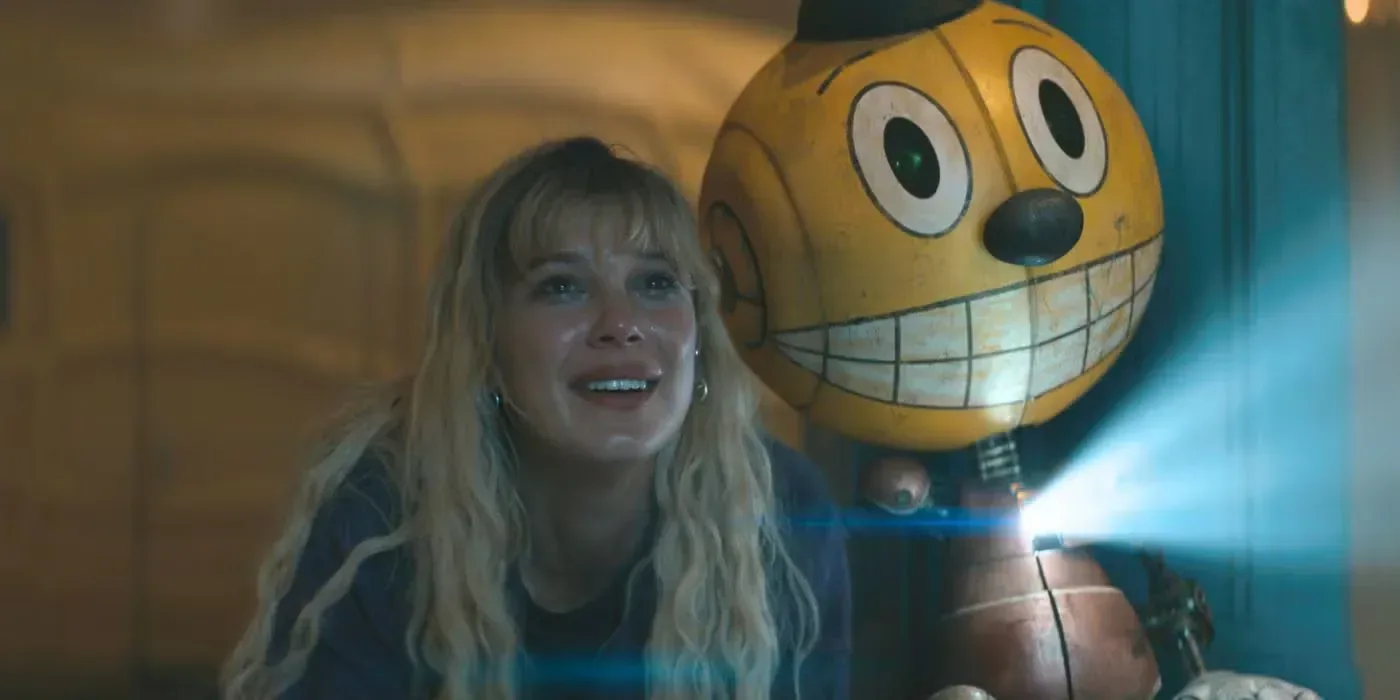
Dr. Amherst (Ke Huy Quan) had engineered a loophole through which Christopher could project part of his awareness into Cosmo (voiced by Alan Tudyk), a small robot modeled on an animated cartoon character from a series Christopher recognized from childhood. That connection is how Christopher guided Michelle across the robot Exclusion Zone toward Seattle without his sister realizing what she was following.
The film, set in an alternate 1994 America, establishes that Christopher was discovered comatose after a car accident and that Ethan Skate (Stanley Tucci), CEO of the tech conglomerate Sentre, had secretly exploited his unusually capable brain to run the company’s Neurocaster network. That system kept millions of people immersed in virtual reality headsets while their physical movements were handled remotely by drones tethered to Christopher’s consciousness. Dr. Amherst explains to Michelle and the smuggler Keats (Chris Pratt) how the loophole functioned and why Cosmo was the conduit.
When Michelle enters the Neurocaster network virtually to reach her brother directly, Christopher tells her the only path to dismantling Sentre is to cut his life support entirely. He also tells her that Sentre has blocked any further consciousness transfer, framing the choice as permanent. Michelle disconnects him. The network collapses. Ethan Skate is arrested.
Why Cosmo Landed in a Junkyard and Not Blue Sky Acres
Cosmo was deactivated the moment Christopher’s life support was severed. The robot became part of the wreckage cleared from the Seattle battle site and was deposited in a junkyard, with no one present who connected the robot to Christopher or could redirect it elsewhere.
Blue Sky Acres is the abandoned mall inside the robot Exclusion Zone where displaced machines had established their community. Popfly (voiced by Brian Cox), Penny Pal (voiced by Jenny Slate), Mr. Peanut (voiced by Woody Harrelson) and the other exiled robots lived there before joining Michelle’s attack on Sentre’s Seattle headquarters. The film shows no one connecting Cosmo to Christopher at the point of the robot’s removal from the battle site. Cosmo had no apparent owner left to claim it or to bring it back to Blue Sky Acres.
Some readings of the ending treat the junkyard as a deliberate statement about expendability, given that the film spends considerable time establishing how the world treats robots as disposable property. That reading has thematic support, but the location is incidental to what the scene is actually doing: staging the revival.
The Dialogue That Sets Up the Closing Image
Earlier in the film, Christopher gives Michelle a framework for the ending they have not yet reached. He tells her that quantum physics holds that particles can remain linked long after they come into contact, and that if consciousness exists as a form of electricity it may be capable of outlasting physical death. That exchange is the film’s clearest attempt to prepare the audience for what happens in the junkyard.
There is a relevant distinction in what Christopher actually said about the transfer block. He told Michelle that Sentre had prevented him from moving his consciousness to another robot. The Cosmo connection predated that restriction and was built on a different mechanism, the loophole Amherst had established. Whether the particle-link logic Christopher described could allow something to persist in Cosmo without constituting a new transfer is the ambiguity the film is working with. The closing shot, in which Cosmo’s reflection appears in standing position while a dog drinks nearby, offers no answer.
The Ringer’s review described it as the film trying to soundtrack a call to arms with an earnest, minor-key piano cover of Wonderwall. That is one critical position. What is not in dispute is that the directors chose a song strongly associated with wistful longing to accompany a scene of uncertain hope.
What the Russo Brothers Have Said About a Sequel
Joe Russo told Entertainment Weekly that no sequel is in active development, though he noted a potential television series is under discussion. “We love immersive worlds, so we always try to build worlds that have the capability for future storytelling,” he said. “There is a game currently that’s being released with the movie, and we’re in discussions around a potential show idea that could work for it, but no sequel conversations as of yet.”
The tie-in mobile game, The Electric State: Kid Cosmo, released on iOS and Android on March 18, 2025, as a prequel set before the events of the film.
The film received a 14 percent critics rating on Rotten Tomatoes, a 30 out of 100 on Metacritic, and three Razzie Award nominations. It also drew 25.2 million views in its first week on Netflix and accumulated 74.2 million views through the first half of 2025, making it one of the platform’s most-watched films despite the critical reception (Netflix What We Watched report, H1 2025).
How This Ending Compares to the Source Novel
Simon Stalenhag’s 2018 illustrated novel, on which the film is loosely based, treats Christopher as a darker figure whose neurocaster-linked abilities were unpredictable and, in at least one episode described in the book, lethal. The novel ends with Michelle at a coastal location, the final illustrations showing an abandoned car and a missing kayak: a conclusion that leans into loss rather than possibility.
The film replaced that register with something more legible and more hopeful. Christopher’s sacrifice is framed as an act that simultaneously frees him and dismantles Sentre’s hold on society. Cosmo’s revival pushes further still, cracking the door toward continuation rather than sealing it.
That crack may never lead anywhere. Joe Russo said as much. What Cosmo’s reactivation actually changes is the emotional logic of the film’s central sacrifice. Michelle believed she was saying goodbye permanently. The junkyard scene complicates that belief, and it does so without giving her or the audience any way to verify what, if anything, is still inside the machine.