Netflix’s ‘The Electric State’ Ending Explained: What role does Dr. Amherst play in helping Michelle?
Dr. Clark Amherst opened the covert channel that let Christopher reach Cosmo, then built P.C. to guide Michelle through Sentre headquarters in the finale.
Spoilers follow for the full ending of The Electric State, including Christopher’s fate and the final scene.
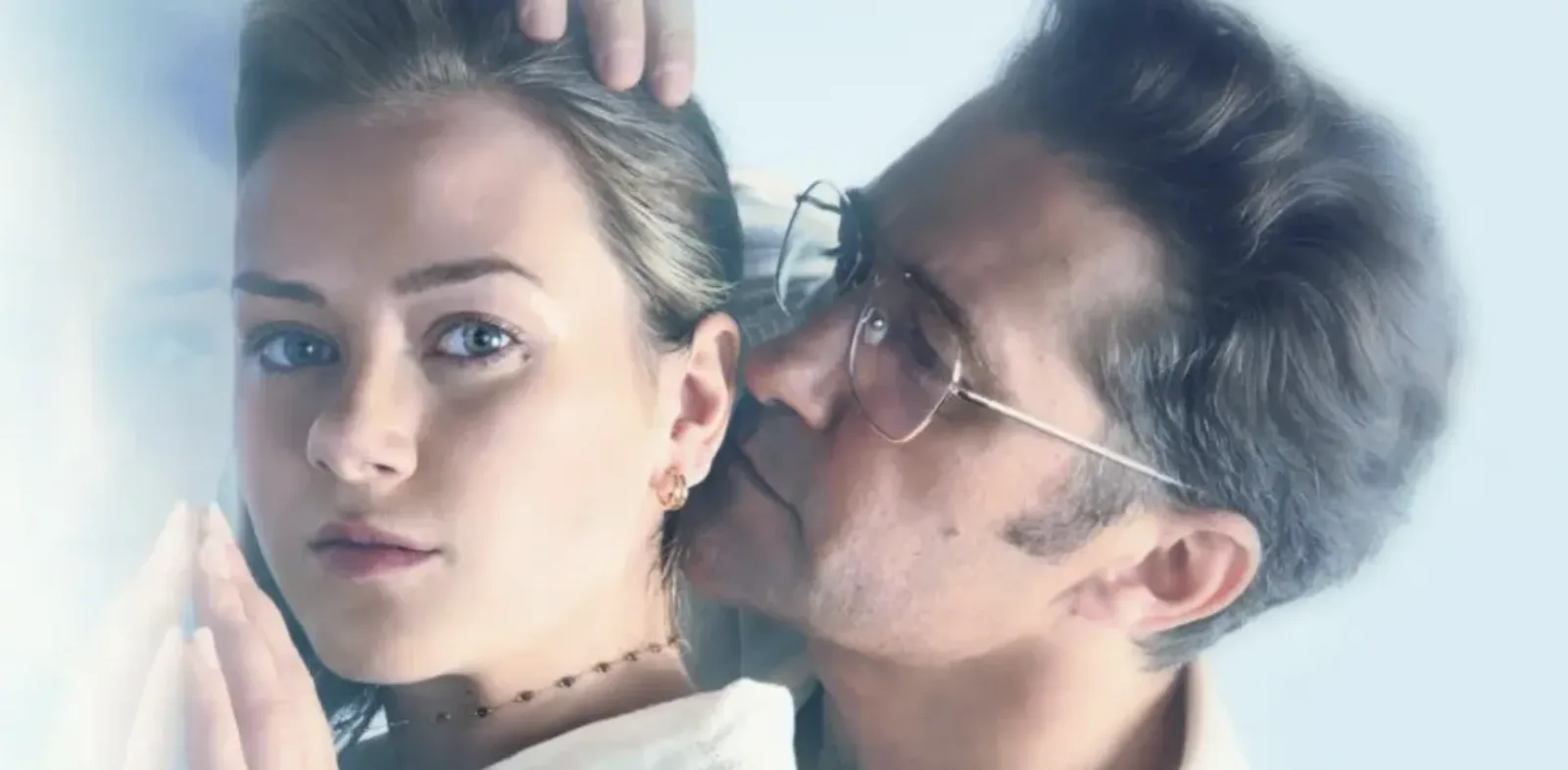
Dr. Clark Amherst (Ke Huy Quan) is the reason Michelle (Millie Bobby Brown) can find her brother at all. The Sentre scientist who first brought Christopher into Skate’s system spent years trying to undo that decision, opening a covert channel that let Christopher’s consciousness escape into the robot Cosmo and building a companion robot, P.C., that carries his voice and knowledge after he is killed. Without Amherst’s intervention, Michelle has no lead on Christopher’s whereabouts, no guide inside Sentre headquarters, and no way to reach him in the film’s final act.
Who Dr. Clark Amherst Is
Amherst was a scientist at Sentre, the corporation run by Ethan Skate (Stanley Tucci) that developed Neurocaster technology in an alternate version of 1994. Neurocasters let soldiers remotely inhabit drone robots during a human-robot war; Sentre’s hardware won the conflict, after which machines were banned and confined to an Exclusion Zone.
After the car accident that killed Michelle and Christopher’s parents, Christopher ended up in Sentre’s possession. Amherst’s own diagnostic work revealed that the boy’s unusual brain chemistry was suited to running the Neurocaster network at scale. Skate moved forward. Christopher, a child prodigy who had enrolled in college years ahead of his peers, was kept in a comatose state, his consciousness turned into the processing core for every drone Sentre controlled.
Ke Huy Quan, who won the Academy Award for Best Supporting Actor for “Everything Everywhere All at Once” (2022), described Amherst in a Netflix interview as someone who “suppresses his morality to get what he wants.” He is both the person who enabled the system that imprisoned Christopher and the person who later built the workaround that let Christopher escape.
How Amherst Connects Christopher to the Outside World
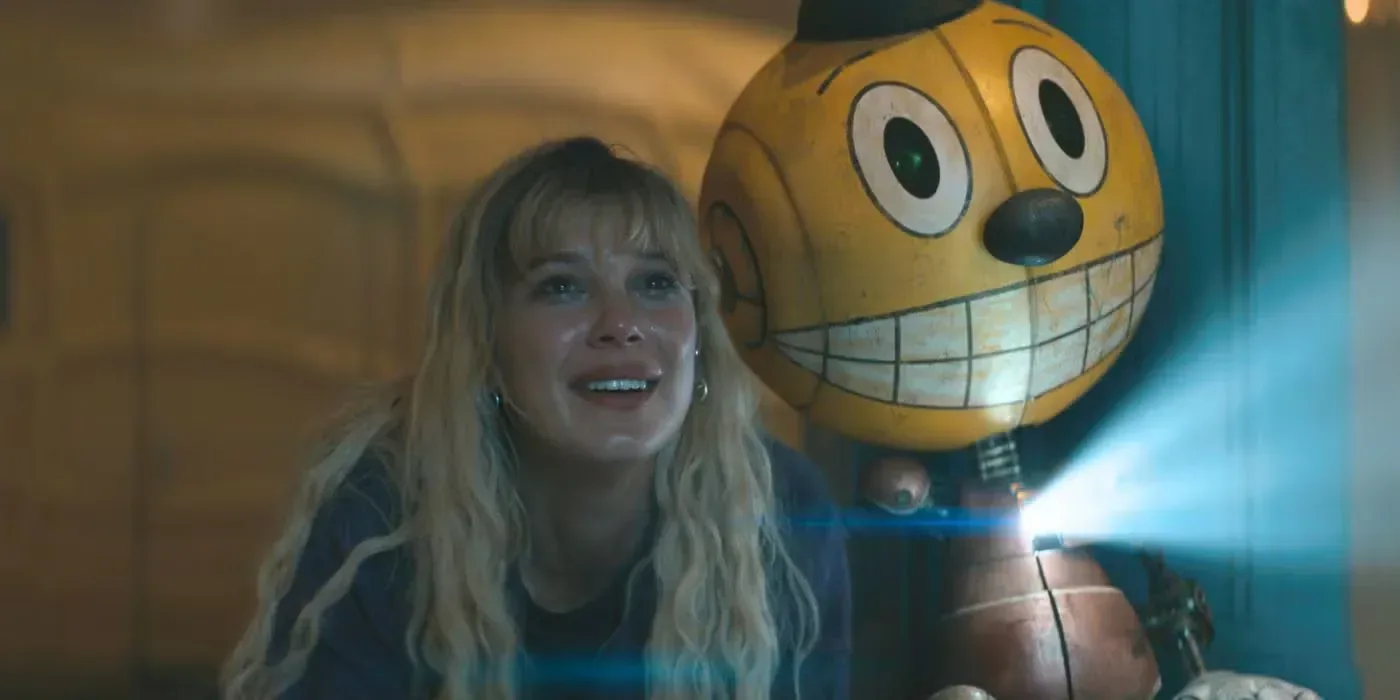
Unable to accept what Sentre had done, Amherst eventually found a technical way for Christopher’s mind to communicate beyond the closed Neurocaster network. That workaround allowed Christopher to partially inhabit Cosmo, a small toy robot voiced by Alan Tudyk, and use it to make contact with Michelle. Cosmo’s arrival at Michelle’s home, where it communicates through gestures and stored phrases that carry Christopher’s personality, is what sets the film’s plot in motion.
Amherst had retreated to the robot Exclusion Zone, a Mojave Desert sanctuary for banned machines, with a nearby community called Blue Sky Acres serving as a gathering point for rebel robots. He also built P.C. (also voiced by Ke Huy Quan in a dual role), a robot companion modeled on his own voice and designed to carry his knowledge forward once he was gone.
Amherst’s Death and What Survives Him
Amherst does not survive long enough to help Michelle directly. After Skate discovers that someone has opened an unauthorized connection to the Neurocaster network, Colonel Marshall Bradbury (Giancarlo Esposito) sends drones to attack the Exclusion Zone settlement. Skate then kills Amherst personally after seizing control of a drone. Cosmo is captured, and Christopher’s consciousness is pulled fully back into the Sentre network, restoring Skate’s total control of the drone army.
What survives is P.C. Amherst built the robot with his own voice and technical knowledge, and it becomes Michelle’s guide through Sentre headquarters in the film’s final sequence.
The Infiltration and What Michelle Finds
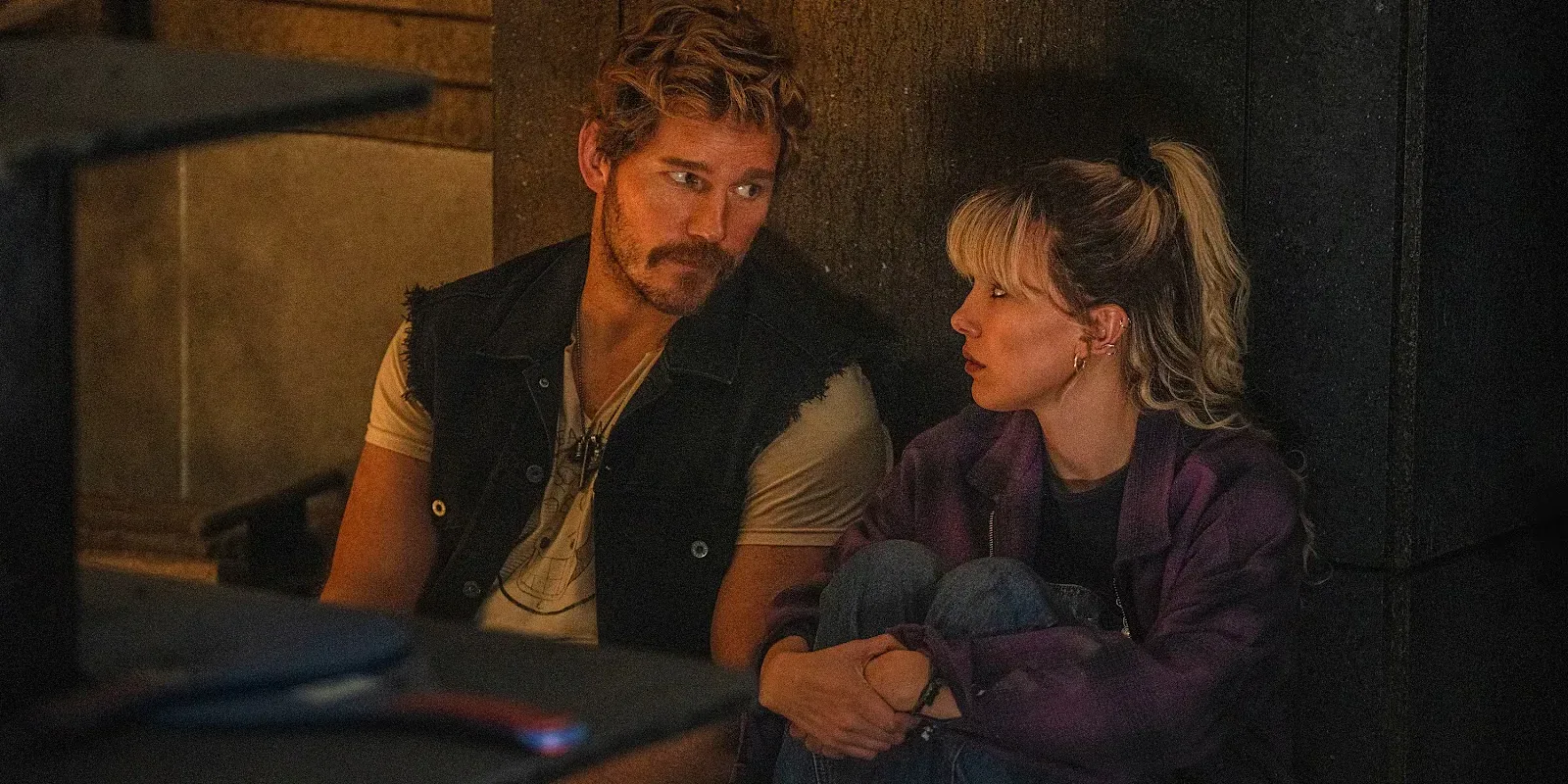
Inside Sentre headquarters, Michelle and P.C. locate Christopher in a comatose state, his brain still powering every drone in the network. While Keats (Chris Pratt), Herman (Anthony Mackie), Mr. Peanut (Woody Harrelson), and rebel robots from Blue Sky Acres hold Sentre’s forces at the perimeter, Michelle reaches Christopher’s chamber.
To speak with him, she puts on a Neurocaster and enters the virtual space where his consciousness exists. There she meets Christopher, played by Woody Norman, in the form his mind has maintained. He explains that his consciousness and the Sentre network are permanently linked, and that his death would shut down every drone simultaneously. Skate’s engineers had designed the arrangement so Christopher could be sustained in this state for more than a hundred years, but Christopher tells Michelle he wants it to end.
Michelle’s Decision and the Fall of Sentre
With Christopher’s consent, Michelle returns to the physical room and disconnects his life support, causing every Sentre drone to go offline at once. That outcome is possible in part because of a parallel shift: Colonel Bradbury, who had earned a brutal reputation as “the Butcher of Schenectady” for his anti-robot enforcement, breaks with Skate after learning what was done to Christopher. He removes his Neurocaster, refuses further orders, and joins Mr. Peanut in confronting Skate directly, buying Michelle the window she needs.
The news of what Sentre did to Christopher spreads globally. Congress begins subpoenaing Sentre’s executives, and Skate is arrested in Miami while attempting to flee to Ecuador. The robot ban is lifted, and Michelle records a public broadcast calling on people to disengage from the Neurocaster-dependent existence Sentre had built.
What the Final Scene Leaves Open
The film ends with Cosmo, discarded in a pile of scrapped Neurocasters and drone parts, reactivating on its own. No explanation accompanies the moment. It is equally possible that the robot reset to its factory state or that Christopher transferred a fragment of his consciousness before his body died, an idea the film gestures toward when Christopher earlier theorizes about consciousness transcending physical boundaries if everything exists in a state of electricity.
Whether read as sequel setup or as ambiguous comfort, the Cosmo scene changes what Michelle’s decision means retroactively. If any part of Christopher persists in the robot, she did not lose him entirely. She changed the form he exists in, which is a different outcome than the one the rest of the film appears to be building toward.