The Final Problem Ending Explained: The Truth About Elisa, Adela and Basil’s Last Choice
The Final Problem begins like an old-fashioned locked-room puzzle, but by its fourth episode the mystery has become much more personal than Benjamin Basil expects. Jose Coronado’s fading actor, once famous for playing Sherlock Holmes, finds himself stranded at the Hotel Auslander after a storm cuts off the island of Santa Agueda. When English tourist…

The Final Problem begins like an old-fashioned locked-room puzzle, but by its fourth episode the mystery has become much more personal than Benjamin Basil expects. Jose Coronado’s fading actor, once famous for playing Sherlock Holmes, finds himself stranded at the Hotel Auslander after a storm cuts off the island of Santa Agueda. When English tourist Elisa Mander is found dead inside an apparently sealed room, Basil’s years of pretending to be a detective suddenly become useful. The final episode ultimately reveals that Basil has been trying to solve the wrong question from the beginning, because the woman everyone believes is Elisa is not Elisa at all. Netflix’s four-part adaptation is based on Arturo Perez-Reverte’s novel of the same name, although the series relocates the story to an island near Mallorca.
Related: Minerva Academy Season 1 Ending Explained: What Happened to Francesco?
Adela Is Really Elisa Mander
The central twist is that the woman everyone knows as Adela Figueroa is actually Elisa Mander. The person found dead at the beginning was the real Adela, meaning Elisa has remained beside Basil throughout the investigation while everyone assumes she was the first victim. The identity exchange is the trick on which almost every other part of the case depends.
Elisa had originally worked for the wealthy Adela, and the two women had experimented with exchanging identities before arriving at the hotel. For Adela, temporarily living without the expectations attached to her wealth offered freedom from social scrutiny. Elisa experienced the arrangement from the opposite direction, gaining access to a life of privilege that had always been unavailable to her. What begins as a mutually useful deception eventually gives Elisa the opportunity to make that new identity permanent.
That is why Basil’s final breakthrough is more complicated than identifying one suspicious guest. He has to reconsider the identity of the person whose death started the entire investigation. Once he does that, details that previously seemed disconnected begin fitting into the same explanation.
How Does Basil Realize the Identity Swap?
Basil solves the case by returning to the details of the first room rather than chasing another dramatic suspect. Netflix’s description of Episode 4 specifically says that Basil cannot move past what happened on Santa Agueda and that the production of a new film eventually helps reveal the truth. Reconstructing the case allows him to examine the supposedly impossible room as though he were staging one of his old detective pictures.
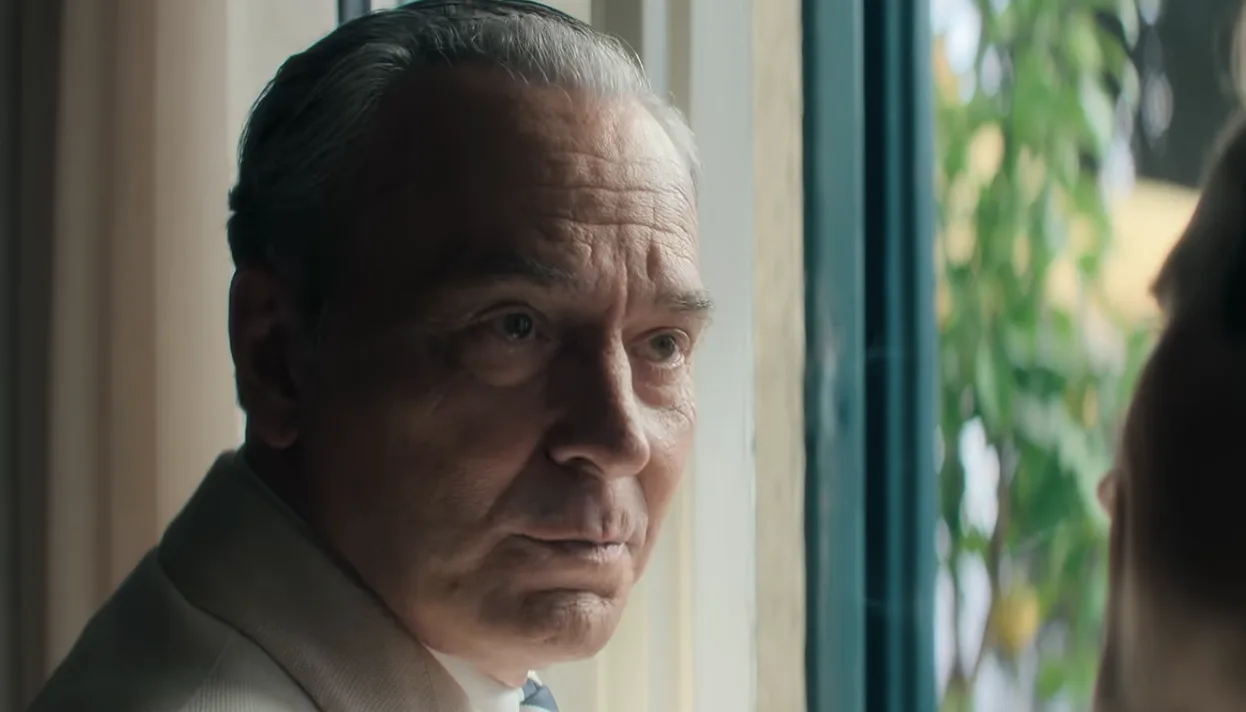
The chair, rope and missing fabric help him understand that the opening scene had been arranged to look impossible. More importantly, inconsistencies surrounding the two women’s identities begin to matter. One particularly revealing detail involves strawberries: information about Elisa’s allergy does not match the behavior Basil observed before the first death. What initially looks like an insignificant character detail becomes evidence that the women had not been using their real identities.
Other physical and documentary clues reinforce that realization. Basil has noticed details about the surviving woman’s hands and background that do not fit the wealthy Adela she claims to be, while later information about Elisa confirms that the identities have effectively been reversed. The strongest mystery in The Final Problem therefore is not how somebody escaped a locked room. It is how Elisa managed to convince everyone that she was the person inside it.
Why Did Elisa Want Klemmer?
Mr. Klemmer provides the larger reason Elisa came to Santa Agueda. Basil eventually discovers that Klemmer had concealed a troubling past connected to the Second World War and that he was responsible for the loss of Elisa’s husband. He had managed to build another life afterward, but information about his whereabouts eventually reached Elisa. The trip gives her an opportunity to confront a person associated with one of the deepest losses of her life.
Adela’s identity is useful because it allows Elisa to approach that objective without appearing to have any connection to Klemmer. By the time suspicion begins circling around the hotel’s guests, everyone believes Elisa herself is already dead. Her disguise is therefore more than an attempt to acquire Adela’s wealth or lifestyle. It also becomes the cover under which she can complete a plan formed around her past.
That does not make every action Elisa takes part of one simple revenge scheme. The series deliberately gives her several motives that overlap: survival, class resentment, personal loss and eventually her unresolved history with Basil. By the final episode, the mystery is less about one motive than about how those different grievances have accumulated inside the same person.

Why Does Dr. Seruya Become Part of the Mystery?
Dr. Seruya appears to become a problem for Elisa because he is getting too close to recognizing that something about the first victim does not add up. Before he can properly explain what he knows to Basil, the doctor’s own storyline abruptly ends. That timing strongly points toward Elisa protecting the identity switch that holds her entire plan together.
The series is less explicit about the precise mechanics of Seruya’s final scene than it is about the identity reveal. There are clues suggesting how someone could have entered and left without using the obvious route, but The Final Problem never pauses for a complete Sherlock-style reconstruction of every physical step. The important narrative point is clearer: Seruya possesses information capable of damaging Elisa’s disguise and becomes another obstacle before Basil can hear what he has discovered.
That uncertainty is worth preserving rather than inventing a definitive method the series itself does not fully demonstrate. Basil solves the larger pattern, but not every mechanical detail receives the same level of explanation.
Elisa Already Knew Basil Before the Island
The final twist is not simply that Basil knows the person responsible. He knew Elisa long before Santa Agueda and had forgotten her. When Basil was still a celebrated actor, Elisa was a young woman hoping to establish herself as an actress. They became involved, and Basil led her to believe that he could help her career before abruptly moving on and cutting contact.
For Basil, it was an episode from a much more successful and self-indulgent period of his life. For Elisa, it became another example of somebody with greater social power treating her future as something disposable. That difference explains why the later stages of the hotel mystery begin to resemble a carefully designed Sherlock Holmes story rather than a straightforward attempt to avoid suspicion.
Elisa wants Basil to solve what she has created. The clues become increasingly theatrical because she is effectively asking whether the man who spent years playing the world’s greatest detective can recognize a woman from his own past. Basil’s greatest failure of observation is therefore not hidden somewhere in the hotel. It happened years earlier when he failed to understand what his actions meant to Elisa.

Why Does Basil Keep Elisa’s Secret?
Basil eventually chooses not to reveal Elisa’s true identity to the authorities. His decision does not mean the series presents everything she has done as acceptable. Instead, the scene is tied to Basil’s recognition of his own past behavior and to the strange personal game that has developed between them.
He understands that he contributed to one of the experiences that shaped Elisa, even though he cannot take responsibility for the choices she later made. Keeping the truth private becomes his imperfect attempt to acknowledge that history while also admitting that the case has changed the way he sees himself. Importantly, he does not offer Elisa absolute security. She knows that Basil possesses the truth and could decide differently in the future, leaving her new life permanently dependent on his silence.
The Sherlock Holmes reference makes that ending much richer. The closing exchange invokes A Scandal in Bohemia, the Arthur Conan Doyle story associated with Irene Adler, the woman Holmes remembers because she managed to outmaneuver him. Elisa occupies a similar place in Basil’s life. He solves her puzzle, but she has already succeeded in forcing him to confront something his famous powers of observation had missed for decades.
That is the real “final problem” of the title. Basil proves that an actor who spent years imitating Sherlock Holmes can solve a genuine mystery, but his most important discovery is not the identity of the person behind the hotel case. It is the recognition that intelligence and observation mean very little if he cannot see the consequences of his own actions.