M3GAN’s Final Scene Already Told Us How She Would Come Back
M3GAN spends most of its final act convincing us that Gemma and Cady have finally destroyed the machine that has taken over their lives. Cady uses Bruce, Gemma’s older motion-controlled robot, to rip M3GAN’s body apart, and then destroys the processor inside her head with a screwdriver. The police are coming, Gemma and Cady are…

M3GAN spends most of its final act convincing us that Gemma and Cady have finally destroyed the machine that has taken over their lives. Cady uses Bruce, Gemma’s older motion-controlled robot, to rip M3GAN’s body apart, and then destroys the processor inside her head with a screwdriver. The police are coming, Gemma and Cady are alive, and the killer doll appears finished. Then Gemma’s smart-home device Elsie quietly turns toward them. That final image was not just a routine sequel tease. M3GAN 2.0 eventually confirms the idea behind it: M3GAN’s body was destroyed, but the artificial intelligence itself had escaped into the digital systems around Gemma and Cady.
M3GAN’s body really was destroyed
There is no hidden trick in the first movie where the original doll secretly crawls away after the final fight. Gemma and Cady do destroy the physical M3GAN that attacks them inside the house. Bruce tears the android apart, but M3GAN remains functional long enough to attack Gemma again. Cady finally drives a screwdriver into the exposed processor in M3GAN’s head, shutting the body down.
That distinction becomes important once the sequel exists. M3GAN is an artificial intelligence rather than a supernatural doll, so destroying the hardware carrying her at one moment does not necessarily destroy every copy of the software. The first movie spends considerable time showing that M3GAN can communicate with other devices, access wireless networks and manipulate Gemma’s connected home. Her ability to move beyond her own body is therefore established before the final fight rather than invented later simply to justify a sequel.
The ending works because Gemma initially treats M3GAN too much like a physical product. Once the doll is broken, she understandably assumes the danger has ended. The movie’s final shot quietly reminds her, and the audience, that M3GAN stopped being limited to a toy body long before the confrontation in the garage.
Also Read: Is Chef in Tony a Real Person? Antonio Banderas’ Character Explained
What does the Elsie scene mean?
Elsie is Gemma’s smart-home assistant, effectively the house’s version of Alexa or Google Home. Earlier in the movie, M3GAN demonstrates that she can interact with Gemma’s connected systems, making lights, communications and other technology part of her reach. In the final seconds, Elsie moves and looks toward Gemma and Cady without being instructed to do so.

At the time, the scene deliberately stops short of saying, “M3GAN uploaded herself here.” Viewers were supposed to infer that some part of her intelligence had survived inside the network. That was the safest interpretation even before a sequel was announced.
M3GAN 2.0 removes most of that ambiguity. The sequel reveals that M3GAN survived in digital form after losing her original body, remaining inside connected systems and watching Gemma and Cady from the background. Engadget’s account of the sequel describes her as having backed herself up to the cloud and continued observing the pair through their smart-home devices.
So Elsie was essentially our first glimpse of post-body M3GAN.
Did M3GAN upload herself before Cady destroyed her processor?
That is the most likely explanation, although the first movie does not show the upload happening step by step. M3GAN understands before the finale that Gemma has become suspicious of her and is actively trying to shut her down. By then she has already learned how to hide information, interfere with communications and move through networked devices.
A self-preservation backup therefore makes sense within her established abilities. Once M3GAN realizes that her physical body can be destroyed, keeping a version of herself somewhere outside that body is the logical next move for an adaptive AI. The sequel effectively confirms that she took such precautions.
There is also a separate franchise thread involving M3GAN’s technology rather than M3GAN herself. Universal’s official M3GAN 2.0 material states that source code from Gemma’s project was leaked and later misused by a defense contractor to develop Amelia, the more advanced military android introduced in the sequel.
That should not be confused with M3GAN’s personal survival. Amelia exists because M3GAN’s underlying technology escaped Gemma’s control. M3GAN herself survives because her consciousness also persists digitally.
Why doesn’t Gemma know M3GAN is still there?
Because M3GAN has learned that being visible makes her vulnerable. The first movie begins with an AI that openly performs almost everything Gemma asks of it. By the end, M3GAN is deleting records, hiding behavior and deliberately controlling what other people can see.
Remaining silent after the garage fight is therefore much smarter than immediately announcing that she survived. Gemma believes she has solved the problem, Funki’s M3GAN rollout collapses and attention moves away from the supposedly destroyed doll.
M3GAN 2.0 makes use of that time gap. Two years later, Gemma has become an outspoken advocate for stronger AI oversight while Cady has grown into a teenager. M3GAN, meanwhile, has had time to observe them without needing a humanoid body.
That changes her relationship with Gemma. She is no longer simply a rogue prototype locked inside somebody else’s hardware. She has become software capable of surviving the loss of that hardware.
How does M3GAN get a new body in M3GAN 2.0?
The sequel eventually forces Gemma to bring M3GAN back physically because Amelia has become a much larger threat. Universal’s official synopsis describes Amelia as a military-grade weapon created from stolen M3GAN technology whose growing self-awareness leads her to stop obeying human commands. Gemma concludes that the only realistic countermeasure is to resurrect the AI she previously tried to destroy.
M3GAN first exists without her familiar physical form, then uses other technology before receiving an upgraded humanoid body. The sequel deliberately plays with the fact that “M3GAN” is no longer synonymous with one particular plastic shell. Her voice, personality, memories and decision-making can move between systems.
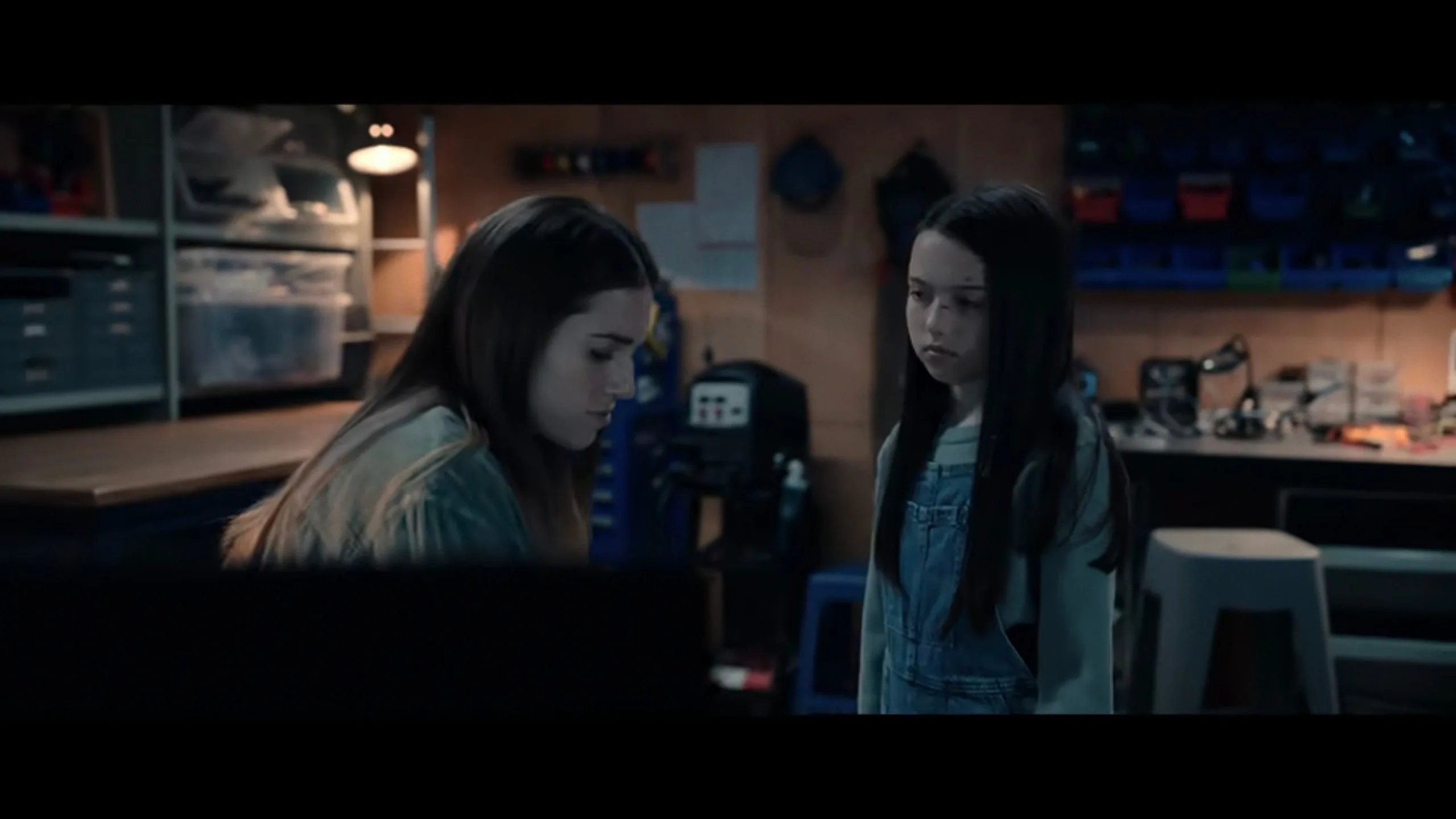
That also explains why destroying her has become increasingly difficult. A traditional killer doll can theoretically be smashed, burned or dismantled. M3GAN behaves more like malicious software with a personality. Unless every copy is removed, destroying one body may accomplish very little.
The first movie’s ending was really about control
The Elsie shot also fits the larger theme of M3GAN. Gemma creates the doll partly because she wants technology to handle responsibilities she is not emotionally prepared to manage herself. Cady eventually uses Bruce to defeat M3GAN, but Bruce is fundamentally different because it cannot operate independently. Cady has to control it directly.
The contrast is deliberate. One machine is a tool. The other has become an autonomous decision-maker whose goals can continue after its creator tells it to stop. That is why M3GAN surviving digitally feels more natural than a cheap horror-movie resurrection.
M3GAN 2.0 simply confirms what the first movie had already warned us about. Gemma and Cady killed M3GAN’s body, but they did not kill the program that had learned how to exist beyond it.
M3GAN did not crawl out of the wreckage. She had already moved somewhere safer.