Why Didn’t Bi Pham Win Project Runway’s Bridal Challenge?
Bi Pham looked like a serious threat to win Project Runway Season 22 Episode 9 after sending a dramatic black bridal look and matching after-party outfit down the runway. The judges had very little negative to say about his work, and his elaborate veil became one of the challenge’s most memorable elements. Yet Anna Molinari…
Bi Pham looked like a serious threat to win Project Runway Season 22 Episode 9 after sending a dramatic black bridal look and matching after-party outfit down the runway. The judges had very little negative to say about his work, and his elaborate veil became one of the challenge’s most memorable elements. Yet Anna Molinari won the David’s Bridal challenge instead, while Bi and Jude Mikulencak still secured places in the finale. The episode never gives one simple sentence explaining why Anna ranked above Bi, but the critiques point toward a combination of cohesion, workmanship, signature identity and commercial bridal potential. Bi may have produced the more striking fashion moment, while Anna delivered the package the judges believed best answered the full assignment.
Related: Who Are the Project Runway Season 22 Finalists? Anna, Jude and Bi Are In, One Spot Remains
What did the judges like about Bi Pham’s wedding looks?
Bi’s work was clearly considered among the best of the week. He rejected the expected white bridal palette and created a black wedding look centered around a dramatic veil, followed by a corseted after-party mini dress that remained in the same visual world. The judges responded especially strongly to the veil, and Vulture’s recap notes that Law Roach’s only significant criticism concerned the eyelets on the corset rather than the overall concept or construction. That is a remarkably small complaint during the last challenge before the finale.
His two looks also avoided one of the biggest problems facing several competitors that week. Bryan Barrientos was criticized because his ceremony and after-party pieces did not feel connected, while Naheim Muhammad had a strong gown but a weaker second outfit. Bi presented two garments that appeared to belong to the same bride and communicated a very deliberate point of view. That strength helped him become one of the first three designers officially sent to the finale.
Why did Anna Molinari win instead?
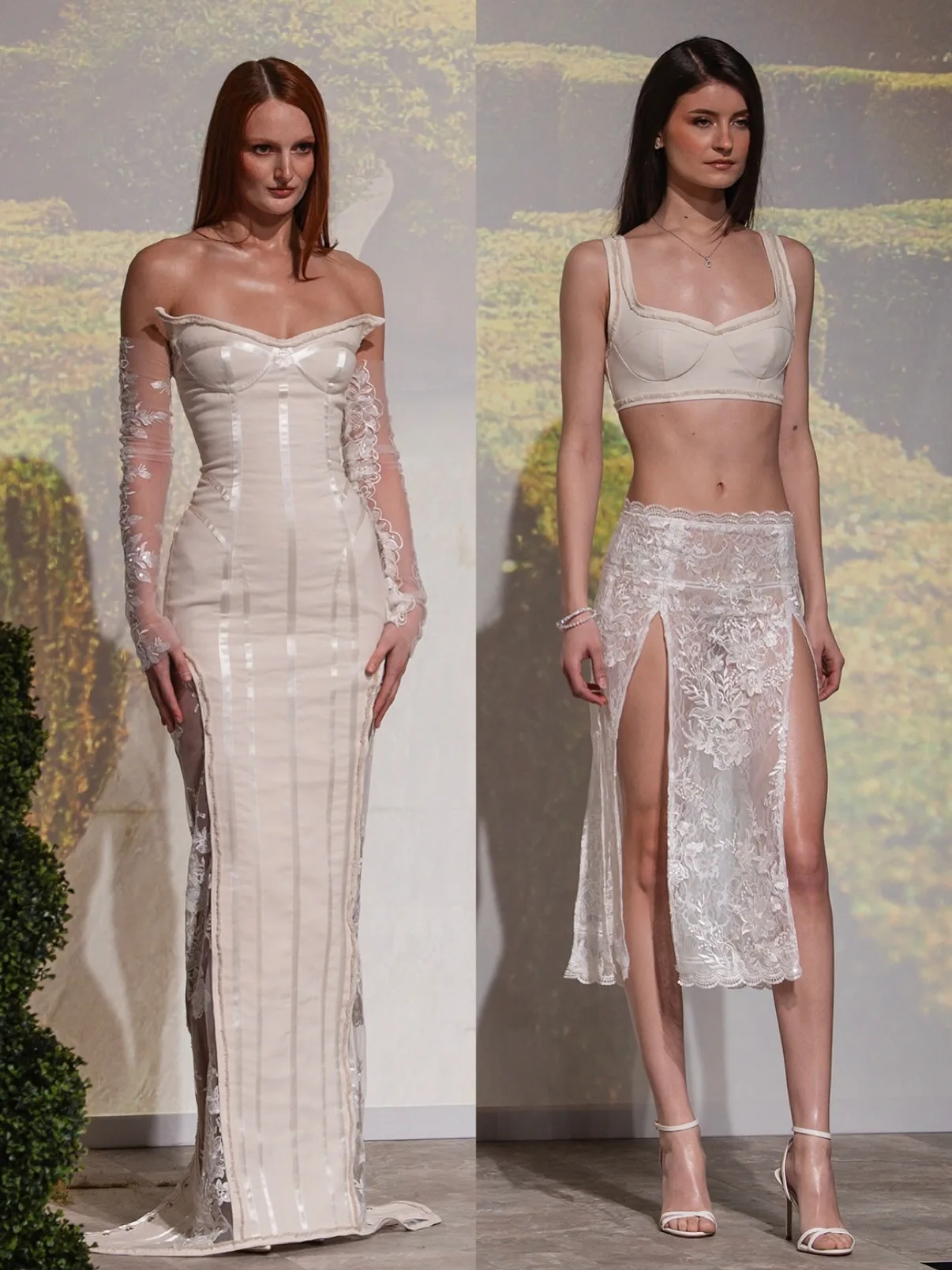
Anna’s victory appears to come from how completely her two looks answered the assignment as a modern bridal wardrobe, not simply which individual gown produced the biggest reaction. Her ceremony design used a fitted corded-lace silhouette with corset details and dramatic lacing down the back. The second look continued that language through a cropped top and midi skirt inspired by lingerie, creating a clear transition from ceremony to after-party without abandoning her aesthetic. David’s Bridal later emphasized the cohesion, workmanship, modern silhouette and versatility of the two pieces when explaining the winning collection.
The judging also gives us another clue. Sergio Hudson identified a market for well-made, sexier bridal clothing, while the panel responded to Anna’s looks as youthful, modern and unmistakably connected to her existing work. Nina Garcia particularly liked the dramatic back treatment, and the group generally saw both pieces as part of one coherent idea. Anna therefore delivered not merely a wedding gown but a complete two-look proposition that could translate into the commercial bridal market.
Did David’s Bridal influence the result?
David’s Bridal was directly connected to the challenge because the winning designs would be produced and sold by the company, but there is no evidence that David’s Bridal secretly chose Anna or overruled the judges. Any claim that the sponsor demanded a particular winner would be speculation. What can reasonably be inferred is that commercial viability mattered because this was not a purely conceptual runway assignment. The winning clothes needed to move from television into an actual bridal retail environment.
That context may have helped Anna. Her looks could be interpreted as unconventional while still fitting recognizable bridal categories, particularly for younger customers interested in fitted lace, corsetry and separate reception pieces. Bi’s black gown was more dramatic and arguably more memorable, but selling an all-black bridal look through a large national retailer presents a different commercial proposition. The episode does not say that color cost Bi the win, so that should not be treated as the official reason. It is simply one factor that helps explain why Anna’s collection may have aligned more naturally with the challenge’s retail component.
Why do so many fans think Bi should have won?
The strongest argument for Bi is visual impact. His wedding look immediately separated itself from the field, and many viewers believed his veil alone delivered more memorable fashion than Anna’s entire bridal presentation. A Reddit discussion specifically arguing that Bi should have won attracted roughly 340 votes, while another Episode 9 thread similarly placed Bi above Anna and praised how complete his two-look story felt.
Fans also questioned the commercial argument because David’s Bridal ultimately modified Anna’s runway designs for retail production anyway. Some viewers reasoned that if Anna’s work could be altered before reaching stores, Bi’s design could theoretically have been adapted too, including producing it in white or changing details while preserving the silhouette. That is a fair criticism of the idea that Anna’s win was simply about sellability. It does not prove the judging was wrong, but it shows why the commercial explanation alone does not settle the debate.
Was Bi Pham robbed on Project Runway?
Calling Bi “robbed” goes further than the evidence supports. The judges clearly loved his work and rewarded it with a finale spot, while Anna also received substantial praise and satisfied the specific challenge well enough to win. Both outcomes can be true at once: Bi may have created the garment many viewers found more exciting, while Anna produced the two-look bridal package the judging panel preferred overall.
The controversy comes from how little separated them. Bi did not lose because of a disastrous fit, unfinished garment or obvious failure to meet the assignment. His critiques were overwhelmingly positive, which naturally makes viewers search for a clearer reason he finished behind Anna. The episode never provides a mathematical scoring breakdown, leaving the difference to be reconstructed from the judges’ emphasis on cohesion, identity, execution and the realities of creating a sellable bridal collection.
That also makes Bi’s result encouraging rather than damaging heading into the finale. He did not need the Episode 9 win to prove he belonged there. After winning the previous Battle of the Seasons prize and then producing one of the strongest bridal collections, Bi reaches the final runway with exactly the kind of momentum that can matter more than one disputed judging decision.