Why did Queen Eloise change her mind about Henry and Lacey’s relationship in Royal-ish?
In Royal-ish, Queen Eloise's stance on Lacey Pope shifts after three things she witnesses: a horse breakthrough, a Binchy exchange, and a quiet exit.
This article covers plot details through the end of Royal-ish, including the final scene.
Queen Eloise (Emily Swain) reverses her position on Henry and Lacey’s relationship because of three things she observes directly: she watches Lacey earn her granddaughter’s trust through patience and psychology, she discovers an unexpected personal connection with Lacey that has nothing to do with royal protocol, and she sees Lacey leave quietly under pressure rather than cause a scandal when either path was available. Those observations change her reading of who Lacey actually is.
Why Queen Eloise Objects at the Start
Queen Eloise’s resistance to Lacey Pope (Nichole Sakura) is not purely about social background. Eloise is a stickler for tradition, and her concern about Henry (William Moseley) centers on whether he takes his duties as a future king seriously. An American theme park performer arriving at the palace reads to her as another sign that Henry cannot stay focused on what matters. Her resistance mixes long-standing tradition with real doubt about where Henry’s priorities lie.
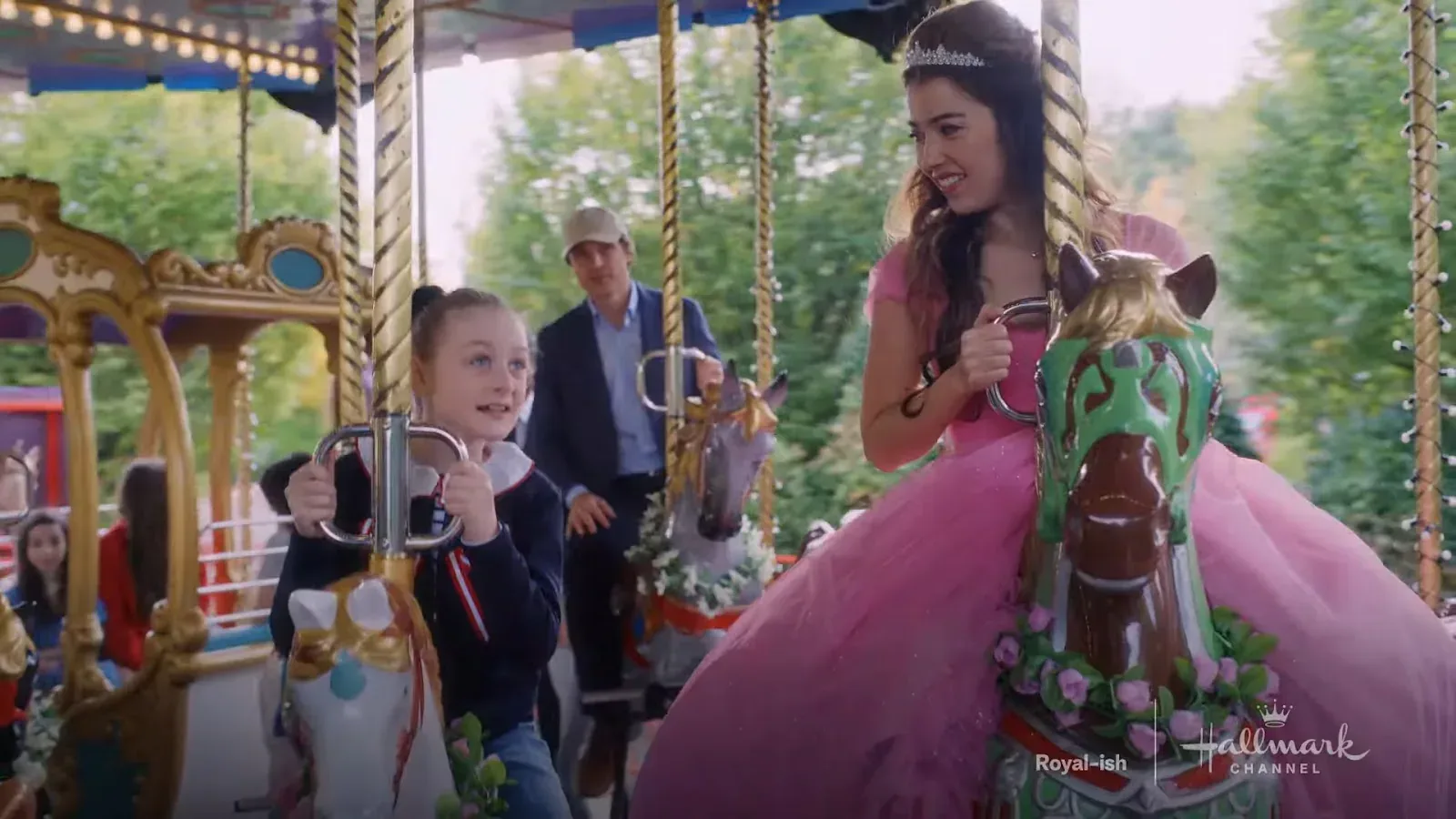
The woman Henry brings home plays Princess Sweet Pea at Emerald Park’s Once Upon a Time Land section in Virginia. Henry hired her as a temporary governess for three weeks after watching her put his daughter at ease during a visit to the park. To Eloise, a woman whose professional role is performing in a sparkly gown for children’s tea parties is not a realistic future queen.
The formal stakes also involve Rose (Francesca Europa, as Princess Caitriona Rose). Eloise had been pushing to move her granddaughter out of school and into full-time palace tutoring, arguing that royal tradition required it. She and Henry reached a conditional agreement: if Rose completes the Order of the Lily, a 500-year-old procession ceremony requiring her to ride a horse, she keeps her place in school.
What Rose’s Progress Shows the Queen
Queen Eloise registers Lacey’s results with Rose before any other part of her opinion shifts. Rose feared horses after a recent fall, a fear compounded by grief over the loss of her mother to cancer years earlier. Every earlier attempt to prepare her for the Order of the Lily ceremony had stalled. Lacey, who had been saving for a master’s degree in psychology before taking the governess position, approached the problem differently: she started Rose on a small pony rather than a full-grown horse and used encouragement over instruction.
Teri Wilson, who wrote the source novel Once Upon a Royal Summer, told TV Shows Ace in a March 10, 2025 interview that “the bond between Lacey and the young princess is an important part of the story.” Wilson also said she could tell “the screenwriters really do their best to honor the original source material,” referring to Tracy Andreen’s teleplay. That bond registers with Eloise. Rebekah’s Readings (March 16, 2025) describes Eloise in this stretch of the film as a “loving grandmother” registering Lacey’s results with Rose, and identifies this as the first point where the Queen’s reading of Lacey begins to shift. Lacey produces results without seeking recognition, which is harder for Eloise to dismiss than a general complaint about her background.
A Shared Interest That Shifts the Personal Dynamic
One of the more specific scenes noted in reviews of the film is a moment in which Eloise and Lacey discover they both read Maeve Binchy. The Irish novelist’s domestic, community-centered fiction is an unlikely shared interest between a reigning queen and a theme park performer. Rebekah’s Readings (March 16, 2025) identifies the Binchy exchange as the point where Eloise begins treating Lacey as a person rather than an inconvenience. The Order of the Lily preparation provides evidence of Lacey’s competence. The Binchy conversation is where the personal thaw actually starts.
Why Lacey’s Departure and Lionel’s Exposure Both Matter
Lacey’s decision to leave without causing a scene is what finally answers Eloise’s core suspicion about her motivations. When photos surface linking her and Henry and threatening a press story, Lacey chooses to leave before the ball rather than wait to be pushed out. She does not speak to the press, does not leverage the royal connection, and exits with the stated aim of protecting Henry and Rose from scrutiny. The History’s account of the film notes that after Lacey’s departure, Eloise acknowledges how much Lacey had changed Henry for the better, and stops treating her as a liability.
The film separates Eloise’s sincere traditionalism from straightforward hostility by placing the harder opposition with Lionel Varon (Brendan Dempsey), a royal advisor who works more actively to drive a wedge between Lacey and Henry. It is the palace governess Miss Daphne (Hannah Brady) who overhears Varon’s scheming and exposes it. When Eloise ends up on Henry’s side against Varon rather than aligned with him, it completes her shift: her concern was always for her son and granddaughter, not for excluding Lacey specifically.
Henry and Rose travel to America to find Lacey, and Henry proposes at the film’s end. A six-month epilogue shows Lacey back in Bella-Moritz, where she has established an equine therapy program in the kingdom, connecting her psychology ambitions directly to what the royal family needs.
What the Queen’s Arc Actually Shows
Eloise’s change of heart is not a last-minute surrender to romance. Her objections at the start were grounded in observable concerns: Henry’s track record of distraction and Rose’s welfare. What shifts is her evidence. Lacey meets Eloise’s standards on the Queen’s own terms, through results with Rose, through personal honesty, and through conduct under pressure, rather than through any argument Henry makes on her behalf.
Wilson’s source novel, published by Hallmark Publishing in 2021 under the title Once Upon a Royal Summer, builds the Queen as a character whose early coldness gradually gives way to warmth. The film, directed by Roger M. Bobb and adapted by Andreen, preserves that structure.