What role does the Shaman Grandpa Kusno play in ‘Sumala’, and what are his two solutions for Soedjiman?
Grandpa Kusno, the shaman in Sumala (2024), offers Soedjiman two options to stop the possession: a ritual before the tenth birthday, or a blessed blade.
This article discusses plot events from throughout Sumala (2024), including character deaths and the film’s ending.
Grandpa Kusno (Budi Gunawan), the village shaman in Rizal Mantovani’s Sumala (2024), is the one character the film positions as having full knowledge of what the supernatural contract demands. Set in the late 1940s in Semarang Regency, central Java, the film follows the consequences after Soedjiman (Darius Sinathrya) kills his deformed newborn daughter, Sumala, violating a deal made with the Devil. When Sumala’s spirit returns years later and begins possessing her surviving twin, Kumala (Makayla Rose Hilli), Soedjiman turns to Kusno as the only person who can explain what is happening. Kusno gives him two options, each tied to the same hard deadline: Kumala’s tenth birthday.
The Contract That Made the Possession Possible
Soedjiman’s wife Sulastri (Luna Maya) made the original pact. Unable to conceive, she sought a ritual that granted her twins: one healthy daughter, one deformed. The Devil’s terms required both children to be raised until their tenth birthday, at which point he would claim the deformed child. When the twins were born, Soedjiman stabbed the deformed infant, Sumala, with a kris (a traditional Indonesian dagger), killing her before the deadline could arrive. That act violated the contract and set the supernatural events in motion. By the time Soedjiman finds Kusno, years later, Sumala’s spirit has already entered Kumala’s body and is progressively displacing her sister’s identity.
The First Solution: A Ritual Before the Tenth Birthday
The cleaner of Kusno’s two options depends on timing. While Kumala has not yet turned ten, the two sisters remain distinct enough within the same body that a ritual separation is still possible. Kusno tells Soedjiman to bring Kumala to him before her birthday: he can perform a ceremony to free Kumala from Sumala’s presence and allow her to live normally again. At that point in the story, the possession is real but incomplete, and Kumala’s own identity is still recoverable. The birthday is the hard boundary. Once that night passes, Sumala’s spirit will fully and permanently replace Kumala’s, and the Devil’s claim becomes irreversible. The first option is the only path that ends with Kumala alive.
The Second Solution: The Blessed Blade
For use after the deadline has passed, or if the ritual cannot be completed, Kusno hands Soedjiman a blessed blade. The instruction is direct: pierce Kumala’s heart, and killing the body destroys Sumala’s hold on it, stopping the violence. Kusno presents this as a last resort. The task falls to a father who spent years mistreating Kumala, and the film positions those two facts in tension: to stop his dead daughter, Soedjiman must kill his living one.
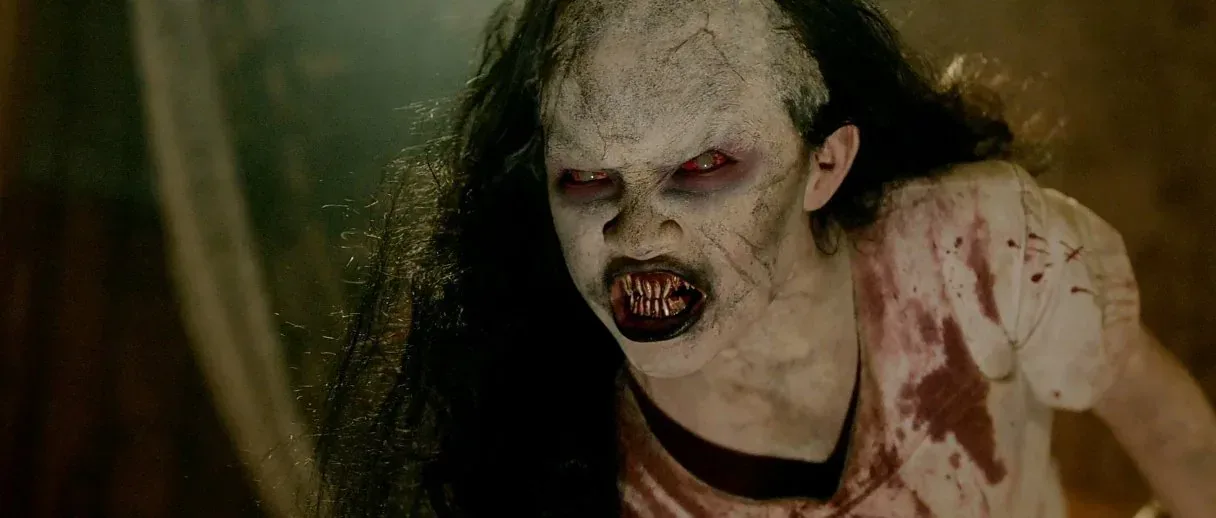
One physical detail complicates the second option and determines its outcome. Because Sumala and Kumala are opposites in every physical way, Sumala’s heart is positioned on the right side of her chest, not the left. When Soedjiman makes his attempt with the blade, he stabs the left side. The wound does not reach the heart. The film presents that failure as anatomical rather than emotional: Soedjiman acts, but acts on the wrong assumption about where the heart is.
What Sumala Does to Kusno
Sumala kills Kusno before either of his proposed solutions can be completed, and his body is later discovered in his chamber. He is the only figure in the film with both the knowledge and the ability to interrupt the possession. His death removes the ritual as an option and also removes the precise physical knowledge, specifically about the heart’s placement on the right side, that a correct use of the blade would require.
What the Two Solutions Reveal About the Film’s Logic
The two solutions Kusno offers establish that the possession is reversible, that a time limit applies, and that the outcome depends on specific human choices made in sequence. The film is not staging an unstoppable curse. It is staging a chain of failures.
Soedjiman killed Sumala at birth, violating the contract Sulastri had made. He mistreated Kumala throughout her childhood, and Sumala’s spirit returned specifically to defend her from those who abused her. When given access to the one person who could end the possession through ritual, Soedjiman did not bring Kumala in time. When he did act, with the blade, he got the anatomical detail wrong. Kusno’s role is to make that chain of causation explicit: the two solutions he lays out are precise enough that the film can trace exactly which choices closed off which exits, and in what order. The film frames the tragedy not as fate but as a sequence of specific failures.