What Condition Does Cecilia Have in Best Medicine? The Mermaid Mystery Explained
Best Medicine has always balanced the eccentric personality of Port Wenn with genuine medical puzzles, and the Season 2 premiere finds perhaps its strangest patient yet. In “Be Careful What You Fish For,” Martin Best encounters a woman dressed as a mermaid in the water outside town, turning what initially looks like another piece of…
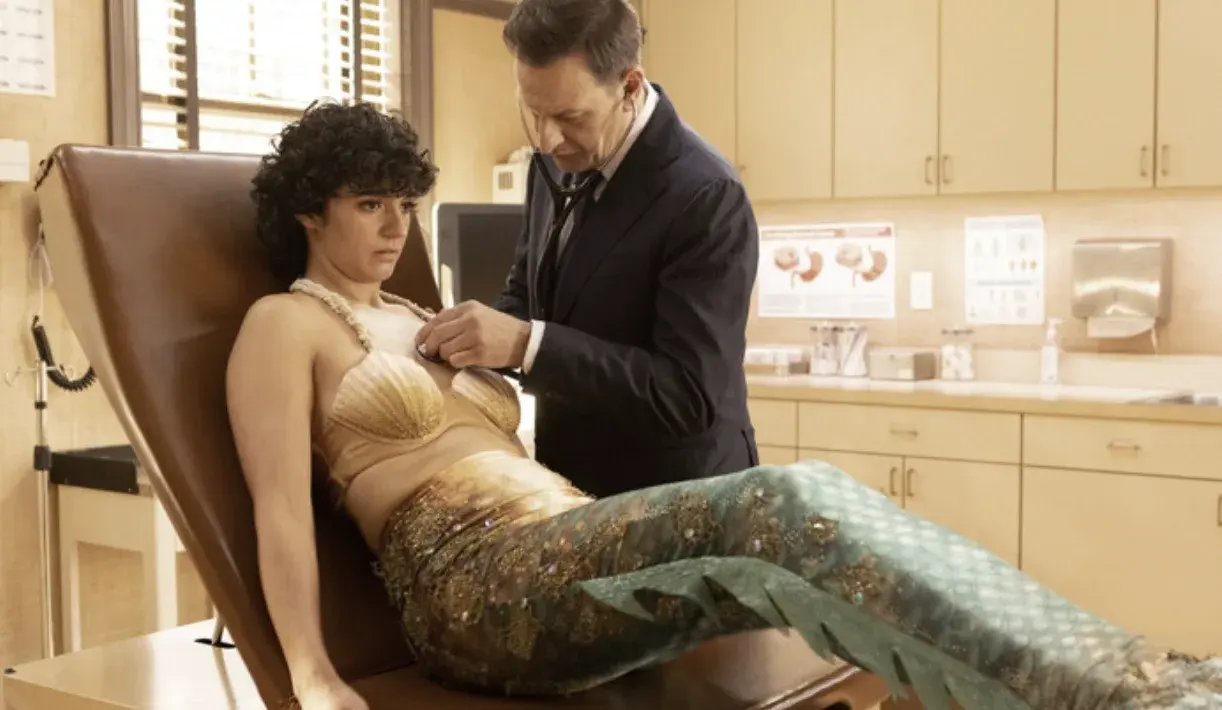
Best Medicine has always balanced the eccentric personality of Port Wenn with genuine medical puzzles, and the Season 2 premiere finds perhaps its strangest patient yet. In “Be Careful What You Fish For,” Martin Best encounters a woman dressed as a mermaid in the water outside town, turning what initially looks like another piece of Port Wenn folklore into one of the episode’s central medical cases.
The woman eventually introduces herself as Cecilia, although she playfully claims her surname is “Mermaid.” Her unusual appearance immediately attracts attention, but Martin eventually realizes that two different medical issues are being confused. Cecilia has a lifelong skin condition called ichthyosis, while the more urgent symptoms that brought her into Martin’s care are linked to prolonged exposure to a toxic algae bloom.
Also Read: Do Alex and Patrick End Up Together in Youth?
Cecilia Has Ichthyosis
Martin identifies Cecilia’s skin condition as ichthyosis after initially considering other possible explanations. The episode shows thick, scale-like areas on her legs, which are not a consequence of spending hours in seawater and have been part of Cecilia’s life since childhood.
Cecilia tells Martin that the condition first appeared on her face and that she has dealt with insensitive reactions to her appearance for much of her life. That history explains why she is uncomfortable when the residents of Port Wenn begin paying so much attention to her.
Ichthyosis is actually a name used for a group of disorders associated with unusually dry, thick or scaly skin. Different forms can vary considerably in severity, and Best Medicine does not identify a specific subtype for Cecilia, so it would be inaccurate to diagnose her beyond what Martin states in the episode. MedlinePlus similarly describes ichthyosis conditions as producing dry, scaly skin and, in some cases, skin thickening.
The important point in the episode is that ichthyosis explains Cecilia’s skin, but it does not explain everything happening to her after she is brought ashore.
Why Cecilia Cannot Speak Clearly
When Martin first reaches Cecilia, she is exhausted and has difficulty speaking clearly. Her condition becomes more concerning when she experiences additional neurological and breathing-related symptoms.
Martin briefly considers whether her skin and the other symptoms are part of the same illness. He eventually rejects that theory once he identifies the ichthyosis, because the skin condition does not account for the sudden changes in her speech or the other symptoms that developed after she was found.
The missing clue turns out to be attached to Cecilia’s mermaid costume. When red-colored kelp is noticed on it, Martin realizes she has been exposed to what the episode calls a “red tide.”
Within the story, that discovery explains why Cecilia’s immediate symptoms appeared after she had spent so much time in the water.
What Is the Red Tide in Best Medicine?
Martin describes the red tide as a toxic algae bloom. Cecilia had remained in affected water long enough for him to connect the exposure with her speech difficulty, seizure and wheezing.
Harmful algal blooms are real. The Centers for Disease Control and Prevention explains that some saltwater algae can produce toxins, with symptoms depending on the specific toxin, the amount of exposure, how someone was exposed and how long the contact lasted. Respiratory symptoms can occur around certain saltwater blooms, while harmful algal bloom toxins more broadly can also produce neurological effects.
That does not mean viewers should interpret Cecilia’s storyline as a precise medical case study. Best Medicine compresses diagnosis and treatment for television, and different types of harmful algae produce different effects. The episode’s key medical distinction is simpler: Cecilia already had ichthyosis before entering the water, while the sudden symptoms Martin is trying to solve come from a separate environmental exposure.
Is Cecilia Really a Mermaid?
No, Cecilia is not actually a mermaid, although she has fun letting Port Wenn believe it for a while. She initially claims that she works as a mermaid performer on a cruise ship and simply fell into the sea after drinking too much.
Mark later discovers that Cecilia has been reported missing from a party boat, which forces her to admit that the story she gave them is not completely accurate. Her mermaid outfit comes from the party, rather than from a mysterious life at sea.
The costume nevertheless becomes meaningful because it reflects how Cecilia has learned to deal with the attention her skin receives. Presenting herself as a mermaid lets her transform something people have judged into part of a character she controls.
TVLine’s recap of the premiere similarly identifies Cecilia’s thick, scaly skin as a longstanding condition while separating it from the symptoms caused by the toxic algae exposure.
Why Cecilia’s Story Becomes Personal for Mark
Cecilia’s arrival also intersects with Mark’s romantic storyline. Earlier in the premiere, Mark tells his mother that he is tired of dating people who seem right on paper and wants to meet someone who makes him smile without effort.
Cecilia does exactly that. Mark is visibly delighted by her almost immediately, much to Martin’s irritation, and his interest continues even after the mystery surrounding her identity is resolved.
The more serious part of their connection arrives later when Cecilia becomes overwhelmed by the attention around her and retreats to the lighthouse. Mark approaches her without treating her appearance as something that needs to be explained or fixed, while the residents of Port Wenn try to convince her that she is welcome among them.
The moment also gives Martin the opportunity to reveal his own blood phobia publicly. The town’s willingness to admit personal insecurities becomes a way of showing Cecilia that everyone carries something they would rather not have judged by strangers. TVLine also notes that Mark’s reaction to Cecilia appears to open the door to a possible new romantic storyline.
Cecilia’s Medical Mystery Has Two Answers
The easiest way to understand the Season 2 premiere is to separate Cecilia’s two conditions. Her distinctive skin is caused by ichthyosis, a condition she has lived with since she was young, while Martin connects her sudden speech, neurological and respiratory symptoms to prolonged exposure to the toxic algae bloom.
That distinction is also central to the emotional point of the episode. Cecilia’s ichthyosis is not presented as something Martin needs to cure before she can be accepted, while the red tide exposure is the temporary medical problem requiring his attention.
By the end of the episode, the mystery of Port Wenn’s “mermaid” has therefore become much more human. Cecilia arrives as the town’s latest curiosity, but her story ultimately allows Best Medicine to explore the difference between treating a medical problem and treating someone as though their appearance itself is a problem.