The Forest Clown: Was Charlie always destined to become a killer, or did his environment shape him into one?
The Forest Clown traces how Charlie went from a boy who wanted to do magic tricks to a killer in the woods, and what the film says made him one.
Spoiler warning: this article discusses Charlie’s childhood backstory, the incident with Sue, and key plot events from The Forest Clown (2025).
The Forest Clown (2025) takes a clear structural position on this question: Charlie’s violence has a biography, not a birthright. Writer-director Lukas DiSparrow builds his character’s origin through a sequence of specific failures, all of them involving the people and circumstances around a child who started out wanting nothing more than to make someone smile. The film does not argue for innate evil. What it does argue, through parallel timelines and flashback sequences, is that cruelty and isolation compound each other in a particular way, and that a particular early incident, involving a girl named Sue and a clown only Charlie could see, closed off the last exit available to him.
One detail, though, refuses to fit the simple “environment shaped him” case.
The Grandfather and the Magic Lessons
The backstory opens on Charlie (Leo Fricker as Young Charlie) being trained in magic by his grandfather (Jeff Turner). The training is not warm. Charlie’s act centers on a balloon trick. The grandfather’s response is frustration. Reviews and summaries of the film consistently describe the grandfather-grandson relationship as the emotional center of the story, and its structure is not complicated. The boy wants approval; the older man withholds it; the sessions continue without the encouragement that would make them feel like lessons.
DiSparrow’s use of magic as the core of this relationship carries meaning through the rest of the film. What Charlie appears to want from the trick is not technical competence but recognition. Our reading is that the balloon, feeble as it is, represents an attempt to produce wonder in front of another person and receive something back. That same impulse, frustrated here, shapes the scenes that follow.
What Happened with Sue
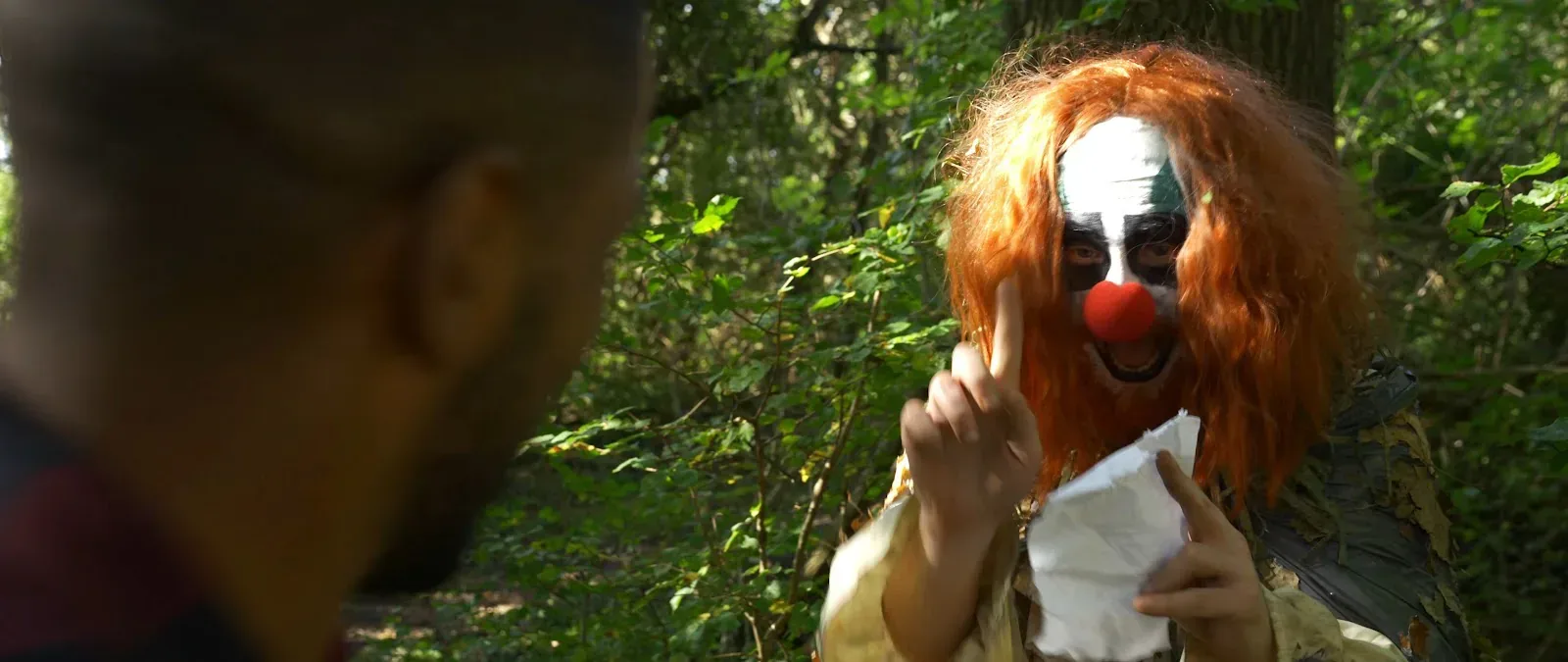
The incident that sends Charlie to the forest involves a neighborhood girl named Sue (Melisa Martinkenaite Zena as Young Sue). The two are children when a clown appears suddenly in Charlie’s room. Only Charlie can see it. Sue cannot. What follows is a confrontation that ends with Sue running from Charlie in fear.
The full cast list complicates this. Adult versions of Sue (Kathryn McLoughlin) and Mike (Nat Landells) both appear in the film’s present-day camping group, alongside the adult versions of their childhood selves. Young Mike (Dexter Rodger) is also visible in the flashbacks as another figure from Charlie’s childhood.
What no available source disputes is Charlie’s interpretation of the event. He believes he has caused serious harm. He does not stay to account for it. He runs into the forest. In our reading, that choice is the structural hinge of the film.
The Clown Only Charlie Can See
Before any failure of adult support, a clown appears in Charlie’s room and is visible only to him. No one else in the scene registers its presence. This is the element that does the most to complicate a straightforward environmental reading, and the film appears to leave it unresolved on purpose.
A viewer review on Plex notes that the clown’s supernatural status is kept deliberately ambiguous. DiSparrow does not explain the apparition within the story’s events. That ambiguity works as a counterweight to the film’s otherwise legible origin-story argument: even before anyone actively rejected Charlie, something in his perception of the world set him apart in a way no adult around him acknowledged or tried to address.
If the clown is a real supernatural phenomenon that only Charlie can perceive, the adults in his life failed him before they ever had a chance to. If it is a projection from an already-fractured mind, then the damage began even earlier than the grandfather’s frustration or the incident with Sue. Either reading makes the environmental argument more nuanced rather than less. The question becomes not only whether people were cruel to Charlie, but whether the cruelty compounded something that was already present and unaddressed.
Charlie’s Parents
Charlie’s father (Chris Sheen) and mother (Kirsty Marie) are listed in the film’s cast, so both appear in the story in some capacity.
What the cast structure does confirm is that Charlie has a family of origin. That their presence does not prevent his withdrawal into the forest points to a failure of support, whatever its specific cause.
When Charlie Comes Back
The present-day story follows a camping group who encounter the clown in the woods. Among them are adult Sue and adult Mike, who connect directly to the childhood flashbacks. The “secrets” that the film’s official synopsis says will “unravel” tie back to the events of Charlie’s childhood. The camping trip is not a random encounter between strangers and a dangerous stranger. Structurally, it is a return to the unresolved injuries of Charlie’s past, brought to a conclusion the adults who survived childhood with him did not choose and cannot escape.
What the Film’s Comedy-Horror Frame Changes
The Forest Clown is a zero-budget dark comedy horror slasher, not a somber psychological portrait. DiSparrow made it on a reported 500 GBP budget with film students, and both his own promotional material and viewer reviews describe it as a deliberate engagement with classic slasher conventions. Characters in the film knowingly break horror-movie survival rules. The film’s IMDB genre listing is Comedy, Horror. That framing sets a ceiling on how far the character analysis can be pushed. DiSparrow is not asking an audience to treat Charlie’s transformation as a clinical case study.
The character logic the film constructs inside that comedic frame is still internally consistent. Charlie is shown an experience no one around him validates. He is denied warmth by the person positioned to provide it. He causes harm he cannot explain or undo, and with whatever support structure his parents might have provided now gone, the forest becomes the only place left.
None of that adds up to destiny. It adds up to a series of missed chances, on the part of every adult who was present, that left one particular child with nowhere else to go.