Shark Tank Season 18 Episode 1 Recap: Wedding Weekender, The Caulking Finger, Ball 2 and FUNDELIVERED
ABC’s “Shark Tank” returns for Season 18 with “Beast Mode,” a premiere built around four businesses that could hardly be more different from one another. Wedding Weekender brings old-school camcorders back into modern weddings, The Caulking Finger turns a contractor’s everyday problem into a patented tool, Ball 2 attempts to combine physical play with AI,…
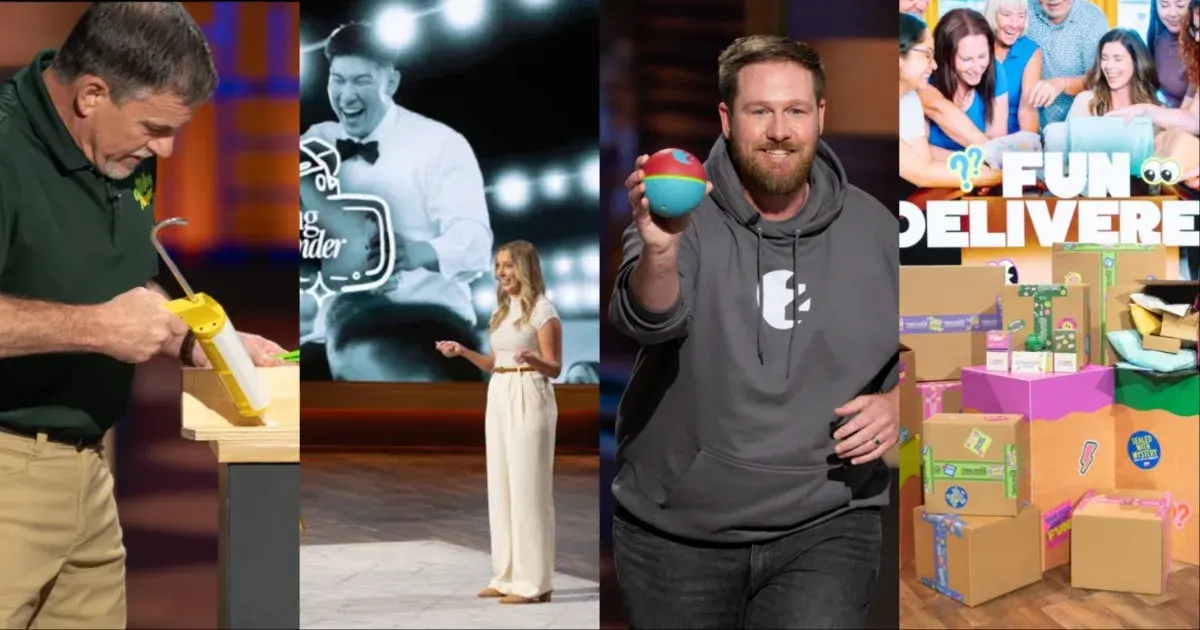
ABC’s “Shark Tank” returns for Season 18 with “Beast Mode,” a premiere built around four businesses that could hardly be more different from one another. Wedding Weekender brings old-school camcorders back into modern weddings, The Caulking Finger turns a contractor’s everyday problem into a patented tool, Ball 2 attempts to combine physical play with AI, and FUNDELIVERED has built an entire business around the excitement of not knowing what is inside a package. Joining the regular Sharks for the premiere are Jimmy “MrBeast” Donaldson and Jeff Housenbold, adding a particularly strong digital-business and consumer-growth perspective to the episode.
What makes these four pitches especially interesting is that none of the founders enters the Tank with little more than an idea. Wedding Weekender has already developed into a fast-growing wedding service, The Caulking Finger has expanded beyond its inventor’s local contracting world, Ball 2 has spent years developing its hardware and software, and FUNDELIVERED has turned mystery packages into a sizable direct-to-consumer business. In each case, the central question is not simply whether the concept works, but whether a Shark can help take an already functioning company to the next level.
Wedding Weekender: Anne Marie Carroll Turns Wedding Camcorders Into a Growing Business
Wedding Weekender was founded by Anne Marie Carroll after her own experience planning a wedding made her think differently about professional wedding videography. Traditional wedding photography and video services can become one of the more expensive parts of a couple’s budget, while some of the most memorable footage often comes from friends and family recording candid moments themselves. Carroll recognized an opportunity to combine those two ideas and build a service around nostalgic camcorder footage.
View this post on Instagram
The concept is straightforward. Wedding Weekender sends camcorders directly to a couple ahead of their celebration, allowing friends, relatives and members of the wedding party to film the events from their own perspectives. After the wedding, the equipment and footage are returned to the company, where the material is organized and professionally edited into a finished wedding video. Instead of having a videographer following the couple throughout the day, the people closest to them effectively become the camera crew.
Carroll launched Wedding Weekender in 2025 after previously working in advertising and marketing. The business began with a relatively small investment in equipment and a website, but social-media interest quickly helped the concept reach couples outside Carroll’s immediate network. Early demand suggested that she had found a middle ground between expensive professional videography and relying entirely on guests’ phone footage.
Wedding Weekender now offers several packages depending on how much equipment and editing a couple wants. The Wedding Weekender Core package includes a camcorder, organized raw footage and a shorter edited video, while the Deluxe package expands the setup with additional equipment and a longer final film. The company also offers packages designed to include bachelor or bachelorette celebrations, allowing customers to document more than just the wedding day itself.
The service has gained attention within the wedding industry as well. Wedding Weekender has been featured by major lifestyle and wedding publications and has continued developing partnerships that put the brand in front of engaged couples. Its social-media presence is built around exactly the kind of footage that makes the service appealing: funny, emotional and unexpected moments captured by people who already know the bride and groom.
The company’s rapid growth makes its “Shark Tank” appearance particularly notable. Carroll is no longer trying to prove that customers will pay for the idea. Instead, the larger challenge is handling equipment inventory, shipping, editing capacity and customer demand while maintaining the personal quality that originally made Wedding Weekender attractive.
For a Shark, the opportunity lies in helping Carroll transform a fast-growing service into a larger wedding-industry brand. Wedding Weekender already has a recognizable concept and clear customer use case, but expanding nationally and internationally requires more than simply buying additional camcorders. Logistics and operational scale could ultimately determine how large the company becomes.
Also Read: The Floor Season 6 Episode 2 Recap: Guenther Wins $20,000 With the Power Shot
The Caulking Finger: Daniel Stephenson Turns Decades of Contracting Experience Into a Patented Tool
The Caulking Finger came from a problem Daniel Stephenson had experienced repeatedly during more than three decades working as a painter and contractor. Applying caulk may seem like a relatively simple part of a renovation project, but smoothing large amounts of material by hand can become uncomfortable and inefficient, especially when working on older homes that require extensive sealing.
Stephenson encountered the problem frequently enough that he eventually decided to build his own solution. Instead of designing an elaborate piece of machinery, he focused on recreating the tool contractors were already using most often: a finger. He experimented with molds and different materials until he developed a reusable tool shaped to smooth caulk while protecting the user’s hand.
View this post on Instagram
The finished Caulking Finger uses engineered rubber designed to provide a balance between flexibility and stiffness. Contractors and DIY users can apply their caulk normally before running the tool along the joint to create a smoother finish. The tool can then be wiped clean and reused, making it a simple alternative to repeatedly using a bare finger.
Stephenson sells the product through FWMM Products LLC, with the company name standing for “Faith Will Move Mountains.” The standard Caulking Finger sells for $9.99, while customers can also purchase two-packs, replacement tips and larger contractor bundles. That relatively low price point gives the product broad potential among both professionals and homeowners tackling smaller renovation projects.
What began as a solution Stephenson created for himself has gradually developed into a retail business. The Caulking Finger has been introduced to contractors and hardware customers beyond Georgia and has expanded its retail footprint through independent stores and larger industry relationships. The company has also promoted the tool through demonstration videos, giving customers an immediate look at how the seemingly simple product works.
The company’s relationship with Sherwin-Williams represents another notable step in its expansion. In 2026, The Caulking Finger announced that it had become involved as a drop-ship vendor connected with Sherwin-Williams and showcased the product at a professional event in Georgia. For a small company, access to established contractor networks can be particularly valuable because the people most likely to understand the product are also the people who may use it repeatedly.
Stephenson’s biggest challenge entering “Shark Tank” is therefore less about explaining why the tool exists and more about getting it in front of enough customers. The product is inexpensive, easy to demonstrate and built around a problem that contractors immediately recognize. The right Shark could potentially help with retail relationships, manufacturing and wider national distribution.
The Caulking Finger is also a classic “Shark Tank” invention in the sense that its appeal can be understood almost instantly. There is no complicated subscription model or lengthy technology explanation. Stephenson encountered an everyday problem, created something to solve it, tested it through years of professional experience and then turned that solution into a commercial product.
Ball 2: Kevin Langdon and Andrew Brown Use AI to Reinvent Physical Play
Ball 2 approaches technology from an unusual direction. While many modern entertainment products use apps and artificial intelligence to keep users focused on screens, Ball 2 was created around the idea that technology can instead encourage people to move. The product comes from Sperry Labs, the company founded by Kevin Langdon and Andrew Brown in 2018.
The Ball 2 team spent years developing a physical ball containing sensors capable of recognizing different types of movement. The system can detect actions such as throws, rolls, catches, bounces and spins. Information from the ball is sent through Bluetooth to the Ball 2 application, which then uses those movements as part of interactive games.
View this post on Instagram
The product becomes more unusual through its AI-powered GameMaker. Rather than limiting users to a fixed selection of games, Ball 2 allows players to describe a game idea and use AI to help turn the concept into something playable. That gives families and children the ability to experiment with their own rules instead of simply following games created by the company.
Ball 2 is available in different versions. The standard Ball 2 is priced at $49, while Ball 2 Plus AI costs $69 and includes access to AI-assisted game creation. Customers can also purchase multiple-ball packages, opening the door to games designed around teams or head-to-head competition.
Although AI is one of the product’s biggest selling points, Ball 2 is not entirely dependent on an internet connection. The platform also includes a growing collection of community games that can be played using the ball and application without continually generating something new. That distinction is important because the company’s central pitch is physical activity rather than another screen-centered entertainment experience.
Sperry Labs spent several years developing the product before Ball 2 reached customers. The company’s founders have backgrounds that allowed them to handle different aspects of the technology, including software, engineering, industrial design and hardware development. Building a sensor-equipped ball that can survive normal play while consistently transmitting usable data presents a considerably different challenge from developing a conventional mobile game.
Throughout 2026, the Ball 2 team has continued introducing the product to new audiences through gaming communities, events and collaborations. The company has also used seasonal games and demonstrations to show how the same piece of hardware can support many different experiences rather than functioning as a single-purpose toy.
The larger opportunity entering “Shark Tank” is scalability. Hardware companies face challenges that software startups do not, including manufacturing costs, inventory planning, shipping and quality control. Ball 2 may have already solved the technical problem of making the product work, but turning it into a recognizable toy brand requires a very different kind of growth.
A Shark with experience in consumer products could therefore provide something beyond funding. Retail placement, manufacturing relationships and access to major toy-distribution channels could be critical if Ball 2 is going to move from a technology-focused startup into a product families regularly encounter in stores.
FUNDELIVERED: Rebecca Dallman and Jena Butler Build a Business Around Mystery Packages
FUNDELIVERED began when Rebecca Dallman and Jena Butler discovered that opening unclaimed packages could be entertaining enough to become a business of its own. The pair were already entrepreneurs when they encountered the world of liquidation inventory and package auctions. After purchasing unclaimed merchandise and experiencing the uncertainty of opening it themselves, they realized that customers might pay for that same sense of surprise.
Dallman and Butler launched FUNDELIVERED from a Florida garage in February 2021. Rather than selling the merchandise individually in a traditional resale model, the company packages unclaimed, undelivered, returned and liquidation items into mystery boxes. Customers know how many packages they are buying, but they do not know exactly what will be inside.
View this post on Instagram
That uncertainty is the company’s central product. Someone ordering a FUNDELIVERED box could receive an assortment of unrelated items, turning the delivery itself into an unboxing experience. The model also naturally fits social media, where mystery-package videos have become a popular form of short-form content.
The Mail Mix Mystery Box currently starts at $89.99, while larger options such as the Party Box can cost more than $200 and include significantly more packages. FUNDELIVERED also sells other themed or differently sized mystery boxes, giving customers several ways to participate depending on their budget and how many packages they want to open.
The founders are careful not to present every box as a guaranteed financial windfall. Because the inventory can come from returns, unclaimed shipments and other liquidation sources, individual products may vary in condition or usefulness. The entertainment comes partly from the uncertainty, which means FUNDELIVERED operates differently from a conventional retailer where a customer chooses a specific item.
The business has expanded considerably beyond its garage beginnings. Dallman and Butler eventually made FUNDELIVERED their main focus, and the company has grown its staff and shipping operation while sending mystery boxes to customers across the United States. The founders say the company has shipped more than 150,000 boxes, demonstrating that the appeal has lasted beyond the initial novelty.
Social media remains central to that growth. FUNDELIVERED regularly shares order preparation, package reveals and customer reactions, while unboxing videos effectively become advertising for the next potential buyer. Every interesting package creates another piece of content that can introduce the concept to someone who may never have considered purchasing liquidation inventory before.
Ahead of the company’s “Shark Tank” appearance, FUNDELIVERED also used the television exposure as part of its marketing strategy, including a promotional giveaway tied to the Season 18 premiere. The campaign highlights how naturally the company operates at the intersection of retail and entertainment.
The question facing Dallman and Butler is how large that model can become. FUNDELIVERED has already proven that customers enjoy the experience, but scaling requires a consistent inventory pipeline and enough variety to keep repeat buyers interested. A Shark could potentially help the founders develop new sales channels while ensuring the experience does not lose its appeal as the business grows.
Wedding Weekender, The Caulking Finger, Ball 2 and FUNDELIVERED Face Different Growth Challenges
The four companies featured in the “Shark Tank” Season 18 premiere represent very different stages and styles of entrepreneurship. Wedding Weekender is trying to manage rapid growth in a service-heavy business. The Caulking Finger is an established physical invention that needs greater awareness and retail distribution. Ball 2 has spent years solving a difficult technology and manufacturing problem, while FUNDELIVERED has already demonstrated that mystery-box entertainment can develop into a sizable consumer operation.
That also means the value of a Shark looks different for every founder. Anne Marie Carroll could benefit from expertise in scaling operations and consumer services, while Daniel Stephenson needs broader retail exposure. Kevin Langdon and Andrew Brown face the familiar hardware challenge of expanding manufacturing and distribution, whereas Rebecca Dallman and Jena Butler have to turn a successful internet-friendly concept into an even larger and more durable brand.
The Season 18 premiere consequently offers more than four product demonstrations. Each pitch asks a different version of the same question that has always driven “Shark Tank”: once an entrepreneur proves that an idea can become a business, what does it take to turn that business into something much bigger?