Is Ghost Adventures’ Factory of Fear Really Haunted? The SAW and Blair Witch Location Explained
The setting of the “Ghost Adventures” Season 31 premiere sounds almost too perfectly designed for the series. A decades-old Las Vegas industrial property now contains immersive attractions based on “SAW” and “The Blair Witch Project,” while employees tell Zak Bagans that strange experiences continue after the staged scares are switched off. In “Factory of Fear,”…
The setting of the “Ghost Adventures” Season 31 premiere sounds almost too perfectly designed for the series. A decades-old Las Vegas industrial property now contains immersive attractions based on “SAW” and “The Blair Witch Project,” while employees tell Zak Bagans that strange experiences continue after the staged scares are switched off. In “Factory of Fear,” that combination allows the series to blur the line between a building engineered to frighten visitors and a location that staff members believe may have acquired a reputation of its own. The real history of the address, however, is more interesting and more verifiable than some of the darker stories repeated during the episode.
The place featured on television is not officially called Factory of Fear. That is the episode title. The property is home to The Official SAW Escape and Escape Blair Witch, two licensed Las Vegas attractions created by Egan Productions and located at 2121 Industrial Road, a short distance from the Strip.
Where Is the Factory of Fear Location?
Both The Official SAW Escape and Escape Blair Witch operate from 2121 Industrial Road in Las Vegas. The SAW attraction places guests inside an elaborate multi-room experience inspired by the film franchise, while Escape Blair Witch begins with a fictional investigation at a ranger station before moving through environments inspired by the Black Hills and the Blair Witch mythology. The attractions occupy different areas of the property, which is why the “Ghost Adventures” crew can move from the industrial SAW setting into an entirely different Blair Witch environment without leaving the larger complex.
Jason Egan and Egan Productions developed the attractions in collaboration with entertainment-rights partners. The Official SAW Escape opened in 2018, while Escape Blair Witch followed in 2021. By the time Zak Bagans arrived for “Factory of Fear,” the building had therefore spent years functioning as a purpose-built destination for immersive horror rather than merely serving as an abandoned industrial backdrop.
That distinction matters because many of the unsettling details viewers see on television were intentionally created. Dark corridors, unusual symbols, distressed surfaces, mechanical effects and film-inspired rooms are part of the visitor experience. The interesting question is whether anything remains once those designed scares are separated from the reports made by people who work there every day.
The SAW Meat Plant Is Part of the Fiction
Visitors to The Official SAW Escape enter through the supposed “Egan & Co. Meat Packing” facility, a concept that fits neatly into the industrial world of the movies. The attraction’s own description uses that meat-packing identity as the beginning of its story, and the exterior was designed to maintain the illusion before guests enter. It is convincing enough that someone unfamiliar with the address could easily assume the building genuinely spent decades processing meat.
That is not the most important documented history of 2121 Industrial Road. Before Egan Productions turned it into an immersive attraction, the address had a long association with Las Vegas’ casino-supply industry. For “Factory of Fear,” that real connection is ultimately much more significant than the fictional meat-plant facade because it places the building directly inside an important chapter of the city’s gaming history.
Paul-Son Gaming Used the Building for Decades
Paul-Son Gaming, founded by Paul S. Endy Jr. in Las Vegas in 1963, became a major supplier of casino table-game equipment. Historical company records describe a business that produced or supplied items including dice, casino chips, playing cards, layouts and other gaming equipment. The Las Vegas Sun reported that Endy purchased the building at 2121 Industrial Road shortly after establishing the company and moved Paul-Son there.
The address appears independently in federal corporate records decades later. SEC filings from the 1990s list Paul-Son Gaming Corporation at 2121 Industrial Road, providing considerably stronger evidence of the site’s past than the rumors discussed in “Ghost Adventures.” Contemporary gaming records and advertisements also associate the address with Paul-Son Dice and Card, while the Las Vegas Sun noted that the building was even used in episodes of the television series “Vegas.”
Paul-Son eventually moved from 2121 Industrial Road in the late 1990s. Its corporate descendants continued in the international gaming-supply business, but the old Industrial Road facility moved into a very different phase of its life. That transition from casino equipment factory to cinematic horror attraction gives the location an unusual Las Vegas history even without any paranormal claims.
Is the Building’s Mob History Confirmed?
This is where “Factory of Fear” requires more caution. The episode repeatedly associates the warehouse with the period when organized crime had substantial influence in Las Vegas, and employees repeat stories about hidden money and serious incidents that may have occurred around the property. Zak himself acknowledges during lockdown that much of the building’s history is unknown and that the crew is working partly from speculation.
The timing makes the broader association understandable. The building dates from the era when organized crime was deeply connected with parts of Las Vegas casino history, and Paul-Son’s products were being sold into that same gaming economy. But a connection to the casino industry during that period is not, by itself, evidence that specific criminal activity occurred inside this particular warehouse.
Available historical records strongly document Paul-Son’s presence at 2121 Industrial Road. They do not provide the same level of support for the episode’s more dramatic stories about what allegedly happened inside the property. Those claims are therefore better understood as part of the site’s oral history and the investigation’s working theory, not as established facts about the building.
Why Do Employees Believe Something Is There?
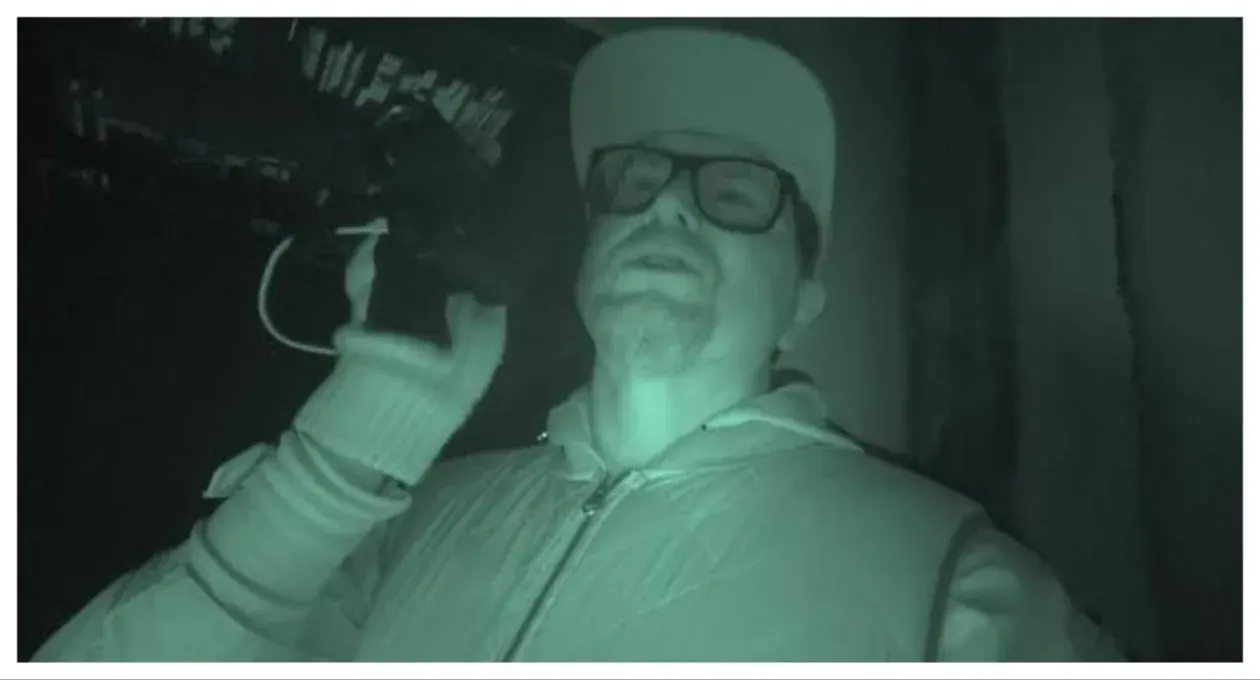
The paranormal reputation described in the episode comes primarily from employees and security personnel. Head of operations Joey tells the crew that he has seen what looked like a person moving through part of the building while he was alone. A night watchman describes seeing a transparent figure in the Blair Witch area and says the experience made him unwilling to work inside that portion of the attraction.
Sarah’s story becomes the central case because she describes a physical sensation around her ankle followed by a frightening experience near the room containing the Witch symbol. Her account predates the crew’s lockdown, which becomes important later when Aaron independently reports feeling something brush the same part of his leg. Billy’s XLS camera then maps a figure low to the floor near Aaron’s ankle, creating the repeated pattern that drives the episode’s conclusion.
Those accounts are meaningful as testimony from people who spend significant time inside the building, but they remain personal reports. “Ghost Adventures” records additional anomalies, unexplained audio, unusual equipment behavior and the moving rover camera, yet none of those recordings establishes a paranormal explanation on its own. Infrared imaging, depth-mapping systems and audio devices can all produce ambiguous information that depends heavily on interpretation.
The Blair Witch Attraction Is Designed to Influence Perception
Escape Blair Witch is particularly interesting in that respect because its official experience is built around suggestion. Guests enter a recreated ranger station and gradually move deeper into environments representing the Black Hills and an isolated house, with lighting, sound, set dressing and live performance all working together to create tension. The attraction succeeds when visitors begin anticipating something before anything actually happens.
For employees, however, familiarity should theoretically reduce some of that effect. They know where performers appear, how the sets operate and which parts of the attraction are artificial. That is why accounts from workers such as Joey, Sarah and the night watchman interest the “Ghost Adventures” team more than the reactions of ordinary customers. Their familiarity does not prove that the building is haunted, but it explains why the show treats their experiences as worth investigating rather than simply dismissing them as responses to the attraction.
The series itself also provides a useful reminder that not every strange image survives scrutiny. During the preliminary evidence review, the crew initially becomes interested in a thermal image that resembles a small figure. When they return to the location, they find an object capable of producing the shape and classify that piece of evidence as debunked. That moment makes the unresolved material more interesting while also showing why visual anomalies should not automatically be treated as paranormal.
So, Is Factory of Fear Really Haunted?
There is no reliable way to state as fact that 2121 Industrial Road is haunted. What can be established is that the building has a genuine connection to old Las Vegas gaming history, that it later became home to two highly immersive horror attractions, and that several people working there have reported experiences they cannot readily explain. The “Ghost Adventures” investigation adds another collection of recordings to those stories, but it does not identify a spirit or establish a paranormal cause.
The episode’s strongest hook is the repetition surrounding the ankle experiences. Sarah describes it before lockdown, Aaron later reports a similar sensation, and the XLS system subsequently maps a figure near Aaron’s ankle. That is an intriguing sequence within the logic of the investigation, but it remains an interpretation of events rather than definitive proof.
In the end, the real Factory of Fear story may be compelling precisely because the verified history and the mythology are so easy to mix together. The address really was tied to the casino-supply business during an important period in Las Vegas history, but its alleged darker past is much harder to document. Today, SAW and Blair Witch fiction has been layered over that authentic industrial background, creating exactly the kind of environment where history, expectation and unexplained experiences can become difficult to separate.