Bloody Tennis Ending Explained: What Happens to Sophie and Bana?
Bloody Tennis starts with the familiar promise of an elite sports movie and gradually turns that promise into something much stranger. Sophie arrives at the remote Mary Tyrone Tennis Academy believing a few weeks of punishing training could finally move her career beyond the modest achievements of her late mother. Mary, coach Stavkos and the…
Bloody Tennis starts with the familiar promise of an elite sports movie and gradually turns that promise into something much stranger. Sophie arrives at the remote Mary Tyrone Tennis Academy believing a few weeks of punishing training could finally move her career beyond the modest achievements of her late mother. Mary, coach Stavkos and the almost silent Fred quickly establish a culture where discomfort is treated as evidence of commitment and friendship is considered a weakness. By the time a Wimbledon wild card becomes the prize, Sophie is no longer simply trying to improve her serve. Nikias Chryssos has described the movie as a story about corruption, and its final stretch shows exactly how thoroughly the academy succeeds in changing her.
Also Read: My Sad Dead Ending Explained: What Happens to Julie and Why Everyone Starts Seeing Ghosts
Why Does Mary Make Sophie Play Bana?
Mary changes the semifinal draw specifically to force Sophie and Bana to choose ambition over their relationship. The two young women have become emotionally and physically close, creating one of the few genuine bonds inside an academy built around constant rivalry. When Mary unexpectedly announces that they will face each other, both immediately understand what she is doing. Sophie briefly suggests they could leave, but the possibility disappears as soon as both admit how badly they want the Wimbledon place.
That is the real test Mary has been preparing Sophie for. Training harder is not enough in her philosophy because a champion must be willing to place victory above affection, loyalty and ordinary moral limits. Mary even tells the players that an opponent can never be a friend, reducing every relationship at the academy to another obstacle between them and success.
Sophie ultimately defeats Bana. The victory matters less for the score than for what it proves about Sophie, because she has chosen the academy’s promise over the person who had offered her some safety within it. Reviews and Chryssos’ own comments similarly frame the movie around the gradual destruction of solidarity under a system where winning is treated as the only meaningful result.
What Happens to Bana After She Loses?
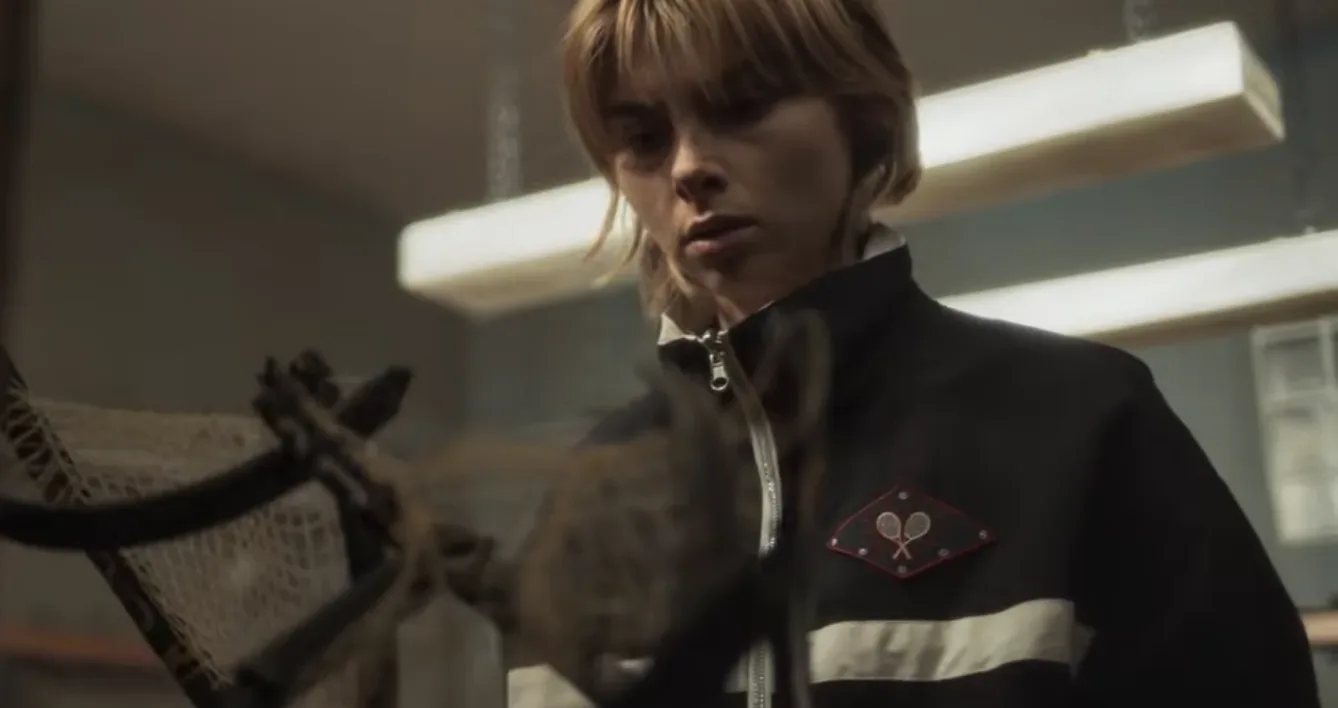
Bana does not simply leave the academy after losing to Sophie. The movie initially follows Mary’s familiar language about eliminated players going home, but Sophie’s later discovery reveals that this has never been the full truth. Fred is preparing the defeated Bana as part of Sophie’s equipment for the final, and Sophie is ordered to participate in making the strings she will use against Nelly.
The moment completes the corruption of Sophie’s relationship with Bana. Earlier, Sophie had recoiled when Fred demonstrated that the academy used natural animal material for its custom rackets. By the final round, she is willing to cross a far more disturbing boundary because withdrawing would mean giving up Wimbledon.
Sandra Guldberg Kampp confirmed in an interview that the production filmed sequences involving Sophie handling internal organs and consuming unusual food during the final portion of the movie. The actress described those scenes as among the most difficult material she shot, reinforcing that the grotesque ritual is meant to be physically real within the film rather than merely a hallucination Sophie experiences.
Why Does Sophie Beat Nelly in the Final?
Sophie initially struggles against Nelly because what happened to Bana has affected her more than she wants to admit. Nelly, meanwhile, reveals that she already understands the academy’s traditions because her own mother, Martina McNair, went through a similar process. She recalls being taught from childhood that sacrifice and emotional hardness are part of preparing for elite competition.
That revelation shows that Mary’s system did not begin with this year’s group. The academy has been reproducing the same mentality across generations, sending successful players into professional tennis after teaching them that compassion is a disadvantage. Nelly is therefore not discovering what Mary wants from her. She has effectively been raised for it.
Sophie nevertheless recovers and wins the Mary Tyrone Girls Cup. Her advantage is no longer simply talent. By this point, she has accepted the academy more completely than she would have thought possible when she arrived, including the belief that another person’s loss can literally become part of her own strength. Mary celebrates her as the academy’s new champion and confirms that the promised Wimbledon wild card is real.

What Is the Meaning of Sophie’s Final Meal?
The meal after Sophie’s victory is the movie’s most extreme version of Mary’s philosophy. Fred prepares a British-style pie while Mary tells Sophie that she has incorporated the strength of the other players. The implication is that the academy does not merely remove competitors who fail. Their bodies become part of the ritual through which the winner is supposedly strengthened.
Sophie no longer responds with the disgust she showed earlier in the film. Instead, she becomes increasingly hungry and demands something fresher when the meal does not satisfy her. Mary then offers herself, suggesting that the academy’s leader views even her own body as another resource that can be passed to the next champion.
The scene should not be read only as grotesque shock value. Chryssos has explained that Bloody Tennis is interested in what happens when people live inside a system where every situation must produce a winner and empathy becomes expendable. Sophie’s appetite becomes the absurd physical expression of that idea. She has been taught to consume rivals professionally, emotionally and finally literally.
Is Mary Tyrone’s Academy Supernatural?
Bloody Tennis deliberately flirts with supernatural imagery without confirming that Mary is a witch or that a magical force controls the academy. There are rituals involving the moon, unusual bodily changes, talk of cosmic energy and Sophie’s increasingly unnatural hunger. The final scenes heighten that uncertainty, especially as Mary’s language turns tennis into something resembling a religious ceremony.
However, the film never identifies a demon, curse or supernatural entity responsible for Sophie’s behavior. One review of the film argues that its horrors are fundamentally human rather than otherworldly, while Chryssos himself has discussed the story primarily in terms of ambition, corruption and the gradual loss of empathy.
The best reading is therefore that the movie intentionally leaves some of its body-horror logic unexplained. Mary may believe completely in the mystical side of her training system, and Sophie may experience physical effects that go beyond ordinary realism, but the academy does not need magic to create monsters. Its most effective tool is simply convincing young athletes that nothing matters more than winning.
Does Sophie Really Go to Wimbledon?
Yes. The final scene confirms that Sophie reaches Wimbledon, with commentary introducing the tournament at the All England Lawn Tennis and Croquet Club as she prepares for her first experience on grass. Mary’s mantra continues over the sequence, turning Sophie’s arrival at one of tennis’ most prestigious stages into the completion of the academy ritual rather than a straightforward sporting triumph.
What the movie does not show is whether Sophie wins Wimbledon. She has achieved the goal that brought her to Europe, but the ending deliberately stops before proving that Mary’s methods can make her a Grand Slam champion. That distinction is important because Sophie has sacrificed far more than she originally imagined for an opportunity, not a guaranteed trophy.
The final irony is that she may have become a much stronger competitor while losing the person she was before arriving. Chryssos’ ending does not ask whether Sophie has enough ability to succeed. It asks whether reaching the top still counts as success when the process has trained her to treat everyone else as something to defeat, use or consume.