Does Taylor Hanson Have Dance Experience Before DWTS?
Taylor Hanson has spent most of his life performing on stages, but dancing has never been a major part of that career. Ahead of “Dancing with the Stars” Season 35, the Hanson singer said he has “virtually no dance experience” and described joining the competition as a significant step outside his comfort zone. His decades…

Taylor Hanson has spent most of his life performing on stages, but dancing has never been a major part of that career. Ahead of “Dancing with the Stars” Season 35, the Hanson singer said he has “virtually no dance experience” and described joining the competition as a significant step outside his comfort zone. His decades as a musician should give him an understanding of rhythm, timing and live performance, but there is no indication that he has formal ballroom training or a substantial dance background. That makes his partnership with professional dancer Britt Stewart considerably different from Season 35 pairings involving celebrities who previously trained or worked as dancers.
Taylor Hanson says he is essentially starting from scratch
Hanson has been unusually direct about his lack of experience. Speaking with “Extra” after the Season 35 cast announcement, he said he had almost no dance background and viewed the show partly as an exercise in facing something that frightened him. He pointed out that much of his performing career has been spent behind a keyboard, which is very different from having every movement evaluated in the center of a ballroom. Rather than presenting his music career as proof that he already knows how to dance, Hanson has described DWTS as learning an entirely new skill in public.
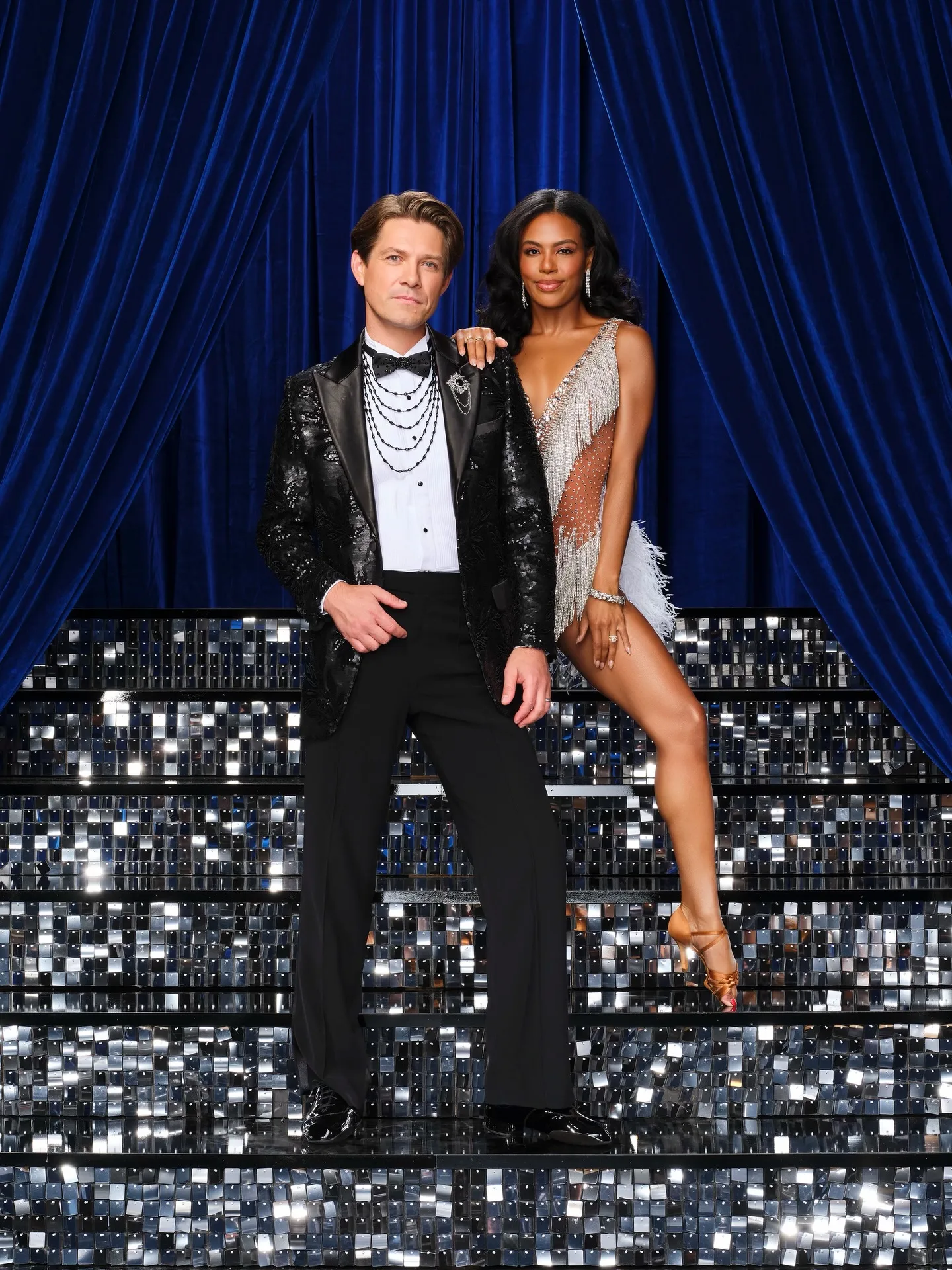
That puts professional partner Britt Stewart in the position of building his technique from the beginning. Stewart described Hanson as teachable during their early interview, an encouraging quality when a contestant does not have years of muscle memory from another dance discipline. In some respects, starting without formal training can allow a professional partner to introduce ballroom posture and movement without first correcting habits from ballet, jazz or contemporary dance. The disadvantage, of course, is that Hanson must learn both the vocabulary of ballroom dancing and the choreography itself at the same time.
Doesn’t performing with Hanson give him some dance experience?
Performing with Hanson gives Taylor plenty of stage experience, but stage experience and dance training are not interchangeable. He has been playing music professionally with brothers Isaac and Zac since childhood, and the band’s 1997 hit “MMMBop” made them internationally recognizable performers while Taylor was still a teenager. Decades of concerts mean he knows how to keep time, engage an audience and continue performing when something unexpected happens. Those qualities can be extremely useful on live television even if none of them teaches him how to execute a foxtrot or cha-cha correctly.
His musical background could be particularly helpful with rhythm. Musicians spend their careers hearing beats, anticipating changes and understanding how a song is structured, skills that can make choreography easier to internalize. Taylor also has considerably more live-performance experience than contestants whose careers are primarily in kitchens, scripted television or social media. The question for DWTS is whether he can convert musical instincts into physical movement while also maintaining the technical requirements the judges expect.
Season 35 makes Taylor’s lack of training more noticeable
Taylor joins a cast where prior dance experience is already one of the season’s biggest talking points. Jenna Dewan began her career as a professional dancer, Harry Shum Jr. is widely known for dance-heavy screen work, and Julia Stiles trained when she was younger before starring in “Save the Last Dance.” Carrie Ann Inaba has cautioned that experience in other forms of dance does not automatically make ballroom easy because the movement, weight placement and technique can be substantially different. Even so, Taylor begins much farther from that world than several of his competitors.
View this post on Instagram
That gap does not necessarily make him a weak contestant. DWTS has always relied partly on improvement, personality and the relationship between celebrity and professional partner, rather than simply rewarding whoever arrives with the strongest resume. A contestant beginning with limited technique also has more visible room to improve from week to week. For Hanson fans who have watched Taylor perform comfortably for decades, seeing him genuinely uncomfortable with a new type of performance may become a major part of his Season 35 story.
Why did Taylor Hanson agree to do DWTS?
Hanson’s explanation centers less on proving that he can dance and more on deliberately attempting something unfamiliar. He told “Extra” that he liked the idea of facing a fear and showing other people that it is possible to learn by actually doing something difficult. For an artist whose professional identity has been firmly established for nearly three decades, that gives the appearance a different purpose than simple career exposure. He is entering a competition where his usual strengths cannot completely protect him.
That is also why describing Hanson as an experienced dancer because he is a musician would miss the central point. He certainly brings rhythm, performance instincts and comfort with live audiences into the ballroom, and those advantages are real. What he does not bring is established ballroom technique or a documented history of formal dance training. Season 35 will test whether Britt Stewart can turn a veteran musician who usually performs behind a keyboard into someone comfortable letting his movement, rather than his music, carry the performance.